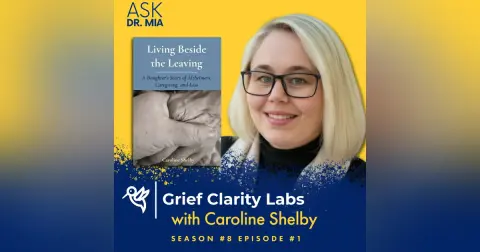
Grief Clarity Labs with Caroline Shelby

 Apple Podcasts
 RSS Feed
 Spotify
 Goodpods
 YouTube
 In this episode, Dr. Mia talks with Caroline Shelby, a grief educator and caregiver, about navigating grief, especially in the context of caring for loved ones with dementia. They explore practical strategies for coping, the importance of acknowledging grief, and how to find clarity amidst chaos.
Chapters
00:00 Introduction to Grief and Caregiving Challenges
03:36 Meet Caroline Shelby: A Grief Educator and Caregiver
04:25 What Would You Tell Your Past Self During Grief?
08:39 Practical Ways to Move Through Grief
13:09 The Role of a Grief Coach vs. Therapist
17:50 Making Difficult Decisions in Caregiving
20:17 Acknowledging and Expressing Grief
23:03 How to Connect with Caroline Shelby
Caroline is a grief educator and founder of Grief Clarity Labs, drawing on more than a decade caring for her mother through Alzheimer's and a series of profound losses in 2024 that turned her personal experience into a calling. Through coaching, writing, and recently published book, Living Beside the Leaving, she helps people understand grief not as something to move on from, but something to learn to move with. Her mission is to help people feel less alone, more understood, and better equipped to navigate one of life's most universal, yet misunderstood, experiences.
SOCIAL MEDIA LINKS:
Website: https://www.griefclaritylabs.com/
LinkedIn: https://www.linkedin.com/in/carolineshelby/
Facebook: https://www.facebook.com/profile.php?id=61580363698420
Instagram: https://www.instagram.com/griefclaritylabs/
Video on Ask Dr. Mia YouTube channel
Transcripts on www.miayangmd.com. Transcripts are automatically generated and may contain minor inaccuracies.
Email: ask@miayangmd.com
Opinions expressed are exclusive of Dr. Mia Yang and not reflective of her or guest speaker's employers or funders.
Welcome to Ask Dr. Mia Answers on Dementia Caregiving. I am your pocket geriatrician and memory specialist. When I was helping my mom with her cancer journey, I knew I wanted to be her advocate and her care partner, but I didn't expect to have to rehash old patterns of communication like a teenager. Combining my knowledge as a specialist for older adults and my own experience as a sandwich generation care partner, I am here to empower you to take practical steps to not only care for the older adult in your life, but also take good care of yourself. Welcome. On this episode of Ask Dr. Mia, I had the pleasure of talking to Caroline Shelby from Grief Clarity Labs, where she works as a grief coach in supporting other sandwich generation caregivers dealing with the challenges of their aging loved ones living with dementia. We talked a lot about the relationship between a child and her mom, who she cared for with dementia. And I shared some tips that helped me in moving through grief when I was going through my own grief journey with my mom's cancer diagnosis. I hope that this episode helps with understanding how to care for yourself as a caregiver, even though everything is oftentimes feeling really heavy, as well as ways of communicating and getting support related to caring for our aging parents with memory impairment. As a geriatrician, I know it's difficult to navigate the healthcare system and not knowing where to turn in terms of information and support. Carolyn offers her own perspective and and her own journey in terms of how she was able to move through her grief journey. I did make her tear up momentarily during this interview, which I think I I have a special knack for. But thank you all for listening and hope you enjoyed this episode. I hope that you walk away feeling like you're not alone and that you're seen and loved by others who are going through something similar. Welcome back to Ask Dr. Mia podcast. I'm Dr. Mia, and today I have Carolyn Shelby with me. She is a grief educator and the founder of Grief Clarity Labs. She took care of her mother with Alzheimer's dementia for more than a decade and really draws on her experience as a caregiver and turned it into coaching, writing, a book to help others move through similar experiences in life. I'm really excited to have her with us today to talk about how to feel less alone in this journey, more understood, and better equipped to really navigate this loss. So thank you so much for joining us, Carolyn.
SPEAKER_01Thank you for having me. I'm very excited to be here and I know it's going to be a great conversation. Absolutely.
SPEAKER_00And so so one of the first things I wanted to ask, and we'll just jump in, something I like to ask all the caregivers that I interview is if you could go back in time and coach yourself when you were going through what many of us know as anticipatory grief with your mom, what would you say and why would you say it? And and just for those who are maybe new to the podcast, anticipatory grief is really this common experience, especially with people going through dementia where the person is still alive and in front of you, but they are we're losing parts of who they are because of their memory loss or their dementia.
SPEAKER_01So I actually I really like this question. And I think there are two things I would probably tell myself. And one of them is you are doing the best you can with the knowledge you have now. I think in any type of caregiving, it is so easy to go back and say, I should have done this, I should have, and we start using that. I don't like that word should because it puts a lot of undue pressure on ourselves. And it's very easy to kind of fall into that trap and add that weight to your shoulders. But someone once told me, anytime you're saying you should have, you're actually working from knowing the outcome. And in the moment, you don't know the outcome. So you have more information than you did in that moment. So you made the best decision you could with the information you had at the time. And we are all human, we're all gonna make mistakes and we're all gonna learn from our experiences, but just kind of being there is enough and trying is enough.
SPEAKER_00Thank you so much for saying that.
SPEAKER_01Yeah. And secondly, I would tell myself to recognize not only to look at what isn't there, but what is there. So, and this is coming from kind of that 20. I it's very hard to do in the moment, but there were moments where we were able to laugh, we were able to talk before she, as she was starting to decline, but was still kind of semi-there, we were able to have some great conversations about who she was, what made her who she was. And my childhood, we were able to talk through some things and whatnot, and I was able to forgive a lot. And a lot of people don't get that chance while their parents are still alive. And so, in a lot of ways, it was both it was also kind of a really it was a blessing and a really great opportunity.
SPEAKER_00Absolutely. And I think you were brave enough to have some of those conversations too, knowing that the time you had with her was limited. And and I had some similar experiences with my mom where, you know, she passed away from cancer, so not Alzheimer's disease, but in some ways also also painful where I knew that she was going to be gone very soon. Um, think uh it's hard to not think about the near future because it feels like it's ever present, like a dark cloud that kind of just follows you everywhere. But it's what you said is so important in terms of also really focusing and looking at the things that are positive or that could be uh interpreted as positive because our brains are naturally geared toward looking at the negative and what we don't have and what we're losing, even though we still have a lot of the person in front of us.
SPEAKER_01Yeah, definitely. And I mean, one thing I try to tell my clients is you're going to have a lifetime to grieve the person afterwards, you know? You're going to have a lifetime to grieve their death. You don't have a lot of time to spend their life with them. So don't give up those opportunities to spend their life to spend those moments with them doing something you're gonna have plenty of time to do later. So, and I think that's a, you know, someone always said to me, don't attend the funeral early. And I think that's a very powerful way of putting it. Yeah, yeah.
SPEAKER_00And and grief really comes in waves. I mean, I think I remember there were some times that it just felt so painful that I could, you know, barely get out of bed, much less be a functioning adult and doing things. I'm curious what were some practical ways that you found helpful in moving through your own grief or in coaching your clients through their grief?
SPEAKER_01So yeah, that's I mean, that's of course very, very common. And of course, when we're a primary caregiver, the option, there is no option to not get out of bed, right? Because there is a human being relying on us being there and present and out of bed. So that is a very difficult dichotomy. And I think the most important thing that I tell a lot of my clients to do is to write some things down. So in those hard moments, either write them down or record them on a voice recorder. I like to encourage my clients every night to try and record or write down one success from the day, right? One thing that went well from the day. Because then that's as our as we're going to sleep and as we're going to bed, that's the energy we're putting into our brain and we're putting into our body, which can, which will help sleep, will also inform, help inform how the energy is stored in the body and how we wake up in the morning. But you also now have a library to go back to in those really hard moments where it's really hard to see the forest for the trees, because it feels like all the trees are falling down on top of you. And you can go back in and either and read that journal or at least listen to those voice notes and say, look, there was that moment. We did have that. And that just it helps alleviate some of that weight. It's never going to make all of it go away. And there are going to be times that it is just heavy and you're you're, you know, dragging your feet out of bed, but it does help kind of give you that extra push.
SPEAKER_00That's a great idea to record the positive moments or the success, even if it's really small. I I definitely kept a journal when I was going. I've always been a journal writer, especially when I'm going through hard times. And but I don't think I consciously recorded down any success. It was more of writing through kind of the pain and using the process of writing to sort through my emotions. And I've always found it easier to write and then sometimes read back what I write. And I'm like, I guess that is how I was interpreting things, and I didn't realize it in the moment. And sometimes it just feels like a swirl of thoughts living in my head, and I couldn't sort through what the heck is going on, but but writing it out really helped me. I also found writing things out in nature was particularly healing. There's a great park garden where I used to live. And I know sometimes when it's really painful, I just would go to that garden and sit there for like 10 minutes and have a cup of tea and write a little bit. And it just felt so much better, even though I didn't really change the situation.
SPEAKER_01Uh my my my my school, the the exercises that I do. But um I think writing it out and or if you're not a writer, because I was never a writer, because I could never read my handwriting. So, you know, look, the invention of smartphones was great because I can talk into it. And that's just how my brain processes, right? I process a lot better talking it out than writing it out. But and I so I greatly encourage people to do that. And, you know, being outside and the vitamin D from the sun and all of that is such a good and healing experience. And I know we all hear that, but it it's really true. On a sunny day, as soon as you walk outside, you can feel your body lighten. And I think processing that grief is very, very important. I generally discourage clients from doing it at the end of the day because we do have a habit of doing that, because that's where we feel like we have a spare 10 moments. But again, that's the energy we're saving in our body as we fall asleep. And that's gonna be a lot harder on our bodies and on our brains. So I think what you did is is is is great.
SPEAKER_00Thank you. Yeah. I stumble into that, did not do it on purpose, but kind of stumbled into what feels good and what what I found helpful at the time. But tell us a little bit more about kind of your role as a grief coach. I know I I don't know if a lot of people know that concept as a a coach to help you through grieving. And how does that differ from, say, a therapist? And how do people know which one they need or both?
SPEAKER_01Yeah. Um that's a very valid question. And honestly, when I was going through it, I did not know what a grief coach was. I had never heard of it until I met my grief coach scrolling through TikTok one night. But uh so I think what it is what the difference is, is as a coach, I'm not only witnessing the pain and supporting the pain, but I'm helping you find I I try and help people find the purpose and look towards the future. I think therapy does a great job of witnessing the pain and kind of teaching you how to hold it and how to carry it, but doesn't do a lot of work towards that future. Also, therapy, when you come upon things like trauma or, you know, thoughts of hurting yourself or things like that, that is always gonna fall on a therapist and not myself. And that is something I would always refer out because that is not my lane at all. And it would be dangerous to try to do anything in that lane. So, so it's kind of, you know, you got to weigh where you are and kind of what is causing the grief, because you can have grief without trauma, but you can't have trauma without grief, right? So you kind of have to look at what's causing the grief and where you are in the process. If you're kind of trying to just get through the now and looking through and looking to process the trauma and, you know, maybe having some dangerous thoughts, things like that, therapy might be better for you. If you're kind of trying to figure out what you want to do with this pain and how to how to grow from it and how to move with it, I mean, we never leave our, we never move on from the pain because it comes with us everywhere we go, but we can learn how to move with it and expand life around it, then that's kind of where the coaching comes in.
SPEAKER_00Gotcha. Thank you for explaining that because I think absolutely it does. It does. And I think I had I had a therapist who really was very helpful during the time that I was caring for my mom. And I knew I needed it because of, you know, things that has happened in the past and our relation, my relationship with my mom, which is probably more complicated than perhaps a lot of other people's relationships with their parents. And and I knew that a therapist could kind of take in what has happened, but also help me kind of process through and how to how to move forward. And I I remember one of the biggest goals that I had during those final months to maybe a year, was I wanted to have no regrets when it comes to my mom's last days. Like whatever I wanted to say or needed to say, or I wanted to get to a point of acceptance because so much of the journey was me not accepting what was happening. And I think that that was really helpful to have someone guiding me through it. And just as I'm sure you're doing a great job of guiding your clients through the grief journey, and that uh I know that with dementia and memory change, grief is something that I know I've mentioned previously on this podcast um many episodes back, but it's really it's really something that a lot of people don't necessarily talk about or name as grief. And that I think once you name it, it's it makes so much sense because you're grieving the loss, and oftentimes that loss is very invisible. I just wanted to actually read a little bit of a little passage of the book that you wrote called Living Beside the Leaving, and because I just thought it was so it captured kind of what that experience was like so well. And this is the section on where you talked about where you had to stop your mom from driving, a very, very painful conversation for many families, and and she really loved driving as part of her identity. So I'll just read for the audience. I picked up the keys, they felt normal. Weight I was familiar with. I had seen her throw them carelessly into her bag for years, spin them around her finger, toss them onto the counter at the end of the day. Now they were in my hand. I felt relief and I felt guilty. Relieved that she wouldn't get lost on a dark highway, relieved that I wouldn't have to answer another midnight call, guilty for taking away something that defined her. As I locked my car that night, I realized how closely I listened to the clicking of the lock. It sounded final. It was the first time I realized that sometimes you love someone by making decisions for them, even if they hate you for it. Sorry. No, don't be sorry. It still brings up those memories. Yeah. I just think you captured it so well. And thank you for sharing that with with everyone in the book too, because I think that so many people are the paying is still so raw, you know, even when after you lose someone. And and I just felt like your writing perfectly captured what so many people are going through that it's just really so hard. Yeah, it is.
SPEAKER_01And I think it's, you know, we talk about you hear a lot of the flowery language of and I said it, you know, you should focus uh, you know, you want to focus on the good and whatnot. But we also do need to acknowledge the pain that is happening. And we can't, you can't, grief is not something you can push down and ignore. You do have to acknowledge it as it comes up, because if you push it down and ignore it, it'll come up twice as big and twice as loud and twice as painful. But so it is important to acknowledge the pain as well as kind of looking at the positive of the experience.
SPEAKER_00Yeah. What are some ways that you encourage people to acknowledge grief? Because I don't think people actually know how to do that.
SPEAKER_01I think the biggest thing is just saying it, you know, saying it, talking about it. I mean, and t talking about the feelings associated with it. I, you know, when I went out with my friends and whatnot, I was scared to death of to talk to talk about, you know, the sadness, the pain, the frustration, the anger, and all of that I was feeling because everybody, you know, we were 30 we were in our thirty mid-30s. Nobody wants to talk about that stuff. They want to go out, have a good time, laugh, and enjoy each other's company. And so, you know, it can start to feel like a very, very isolating experience. And after my mother passed, and I also in the same year experienced multiple other deaths, I realized that it is so important to say it. Just to say it, you know, often lightens the load. And you realize that other people are going through the same experience. I mean, I remember I thought I was crazy because there were times I wished my mother would just die, you know? There were just because I wanted it to be over. I wanted her suffering to be over, I wanted my suffering to be over. It seemed like this just never-ending groundhog day, which with Alzheimer's it really can be. Yeah. Of pain and just confusion. And it just seemed like she, the the quality of her life was just, and I and it was a painful, painful experience. And I remember thinking, then thinking, oh my God, who's who says they would wish their mother was dead? Like that's a sentence that you would never think you would utter. But, you know, and in talking about it, I realized, you know, and going to support groups and things like that, I realized that that was actually very common. And most people have those thoughts. And it's not coming from a, I wish she was dead because I'm an evil person. It's actually coming from a place of love and care because I was wishing she was dead because I wanted her suffering to stop. And that was, and that's a very different experience.
SPEAKER_00Yeah. Yeah. It's the it's the suffering that is that we want to stop. And and sometimes, and we know that there is no way to get out of the suffering until it ends, you know, with death. And I my mom said a lot of those similar things herself. I mean, she didn't have dementia, but she had a very painful journey with ovarian cancer, and she oftentimes said, you know, I just want to die. And and it's hard as a as a family member to hear that because of course we we try to say, you know, mom, don't say that, or, you know, you can keep going. But I think I think she was also talking about the fact that her quality of life was not where she wanted it to be. She was suffering and she wanted it to end earlier than than it was taking. Yeah. But but I think thank you for acknowledging that it's so common and it's not, you know, you're not a bad person for thinking that. You're not a bad caregiver, not bad daughter, son, you know, daughter-in-law. It's just a very human response to a really painful journey that, you know, of course, we all want it to end sooner rather than later, because it's so painful.
SPEAKER_01Right. And I think, yeah, anytime you have that terminal night diagnosis and you know that's the only way out of it, it's a it's a very it's a rational reaction to because you want to find a way out of it. You know, it's like when you when you have the flu, you want the medicine to get rid of the flu, right? Unfortunately, often there's just no medicine that can get you out of it.
SPEAKER_00Yeah. Yeah. Well, Carolyn, how can people find you? How can they work with you or just hear more about the services that you offer?
SPEAKER_01So I'm on all of the various socials under Grief Clarity Labs. I do offer for anybody listening a free 30-minute call with me, no sales. We'll just talk through what you're going through. And I hope you'll take at least one takeaway from it. And you can go to GriefClarity Labs.com slash call for that. And that is grief clarity labsplural.com slash call.
SPEAKER_00Wonderful. And we'll include the links to Carolyn's socials and her website and the show notes. Just final question: why do you call it Grief Clarity Labs?
SPEAKER_01So I kind of came up with my tagline before I came up with my name because I was like, caregiving is chaos, and I want to give clarity to the chaos. And also my mom was Linda, and I lost a dear friend the same year who struggled with his grief for most of his life, named Clay. And so I very specifically wanted to incorporate the C and the L. And so Beef Clarity Labs was born.
SPEAKER_00Thank you. Thank you so much for sharing all of your experience and wisdom with us. And thank you all for listening. And check out Carolyn at the show notes below, and I will talk to you next time. Thank you so much for listening to this episode. Please click the follow button on your favorite podcast platform. Please remember that this is educational content and that do talk to your own doctor if you have specific questions. Original music by Grant Willis. The podcast is edited by Builder Librarian. And finally, please repeat after me by taking care of myself, I can better care for the older adult in my life.