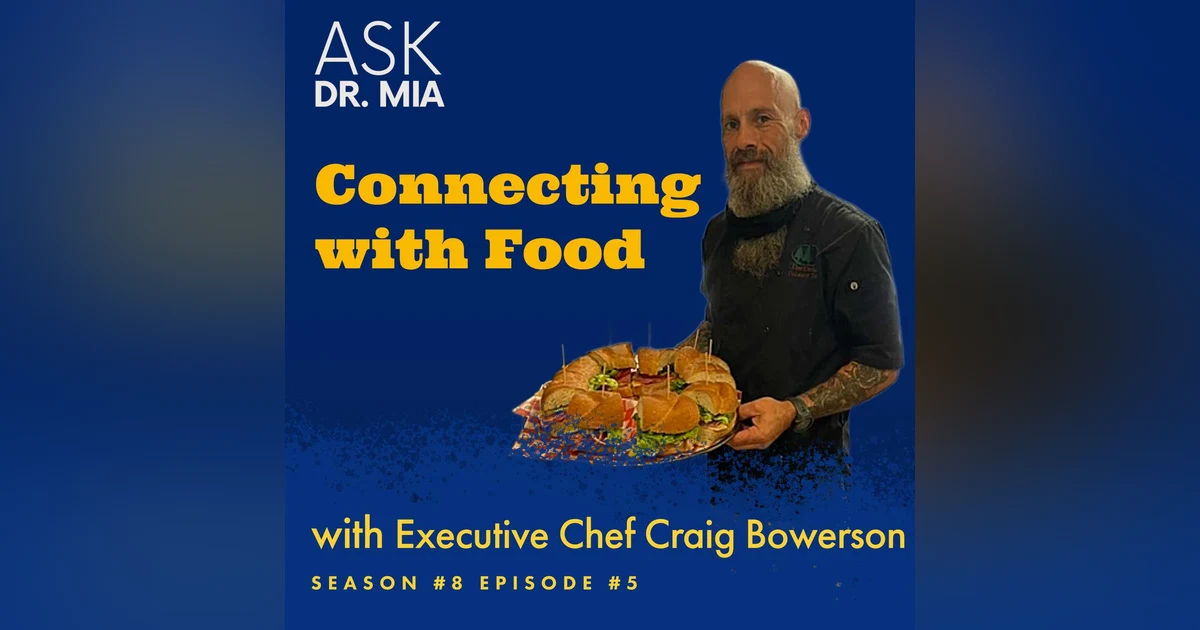
Connecting With Food with Executive Chef Craig Bowerson


 Apple Podcasts

 RSS Feed

 Spotify

 Goodpods

 YouTube
Dr. Mia speaks with Senior-Care Executive Chef Craig Bowerson, a longtime kitchen professional who developed a resident-led menu system, about bringing choice, personal history, and better food to assisted-living dining. They explore practical ways caregivers can use familiar recipes and cooking together to nourish relationships, including when dementia or limited time complicates meal preparation.
Craig Bowerson is an Executive Chef who believes our most vulnerable deserve a higher level of care. A service professional for 33 years, he has worked every position in the kitchen, culminating in the role of Chef. For the past eight years he has served as Chef at a senior care facility, where he developed a groundbreaking menu system that puts choice and power back into residents’ hands and lets them select their own meals. He has made it his mission to prove that budgets are not the enemy of quality.
https://craigbowerson.substack.com/
https://www.youtube.com/@craibow
https://www.instagram.com/craigbowerson
Chapters
00:00 Introduction
01:00 Why family recipes and resident choice matter
03:13 Meet Craig Bowerson and his resident-led menu system
04:44 Staffing, cooking skills, and the cost of prepared food
07:15 How residents help build a personalized menu
09:58 Alternatives, comfort foods, and flexibility at mealtime
11:08 Making cooking manageable for caregivers and people with dementia
13:37 Cooking together to build connection and preserve family traditions
18:32 Simple meal-prep ideas and familiar freezer meals
19:59 The history hidden in old family recipes
23:17 Why dignity and choice drive Craig’s work
26:19 Taking the resident-choice program to more facilities
Video on Ask Dr. Mia YouTube channel
Transcripts on www.miayangmd.com. Transcripts are automatically generated and may contain minor inaccuracies.
Email: ask@miayangmd.com
Opinions expressed are exclusive of Dr. Mia Yang and not reflective of her or guest speaker's employers or funders.
Video on Ask Dr. Mia YouTube channel
Transcripts on www.miayangmd.com. Transcripts are automatically generated and may contain minor inaccuracies.
Email: ask@miayangmd.com
Opinions expressed are exclusive of Dr. Mia Yang and not reflective of her or guest speaker's employers or funders.
Welcome to Ask Dr. Mia, Answers on Dementia Caregiving. I am your pocket geriatrician and memory specialist. When I was helping my mom with her cancer journey, I knew I wanted to be her advocate and her care partner, but I didn't expect to have to rehash old patterns of communication like a teenager. Combining my knowledge as a specialist for older adults and my own experience as a sandwich generation care partner, I am here to empower you to take practical steps to not only care for the older adult in your life, but also take good care of yourself.
SPEAKER_04Welcome. In this episode of Ask Dr.
SPEAKER_03Mia, I talked with Chef Craig Bowerson who went viral with his clips on social media where he was able to solicit treasured family recipes from the residents at the senior care retirement community he works at, and how heartwarming it has been for him to prepare some of these residents' last meals. I made Craig tear up again, seem to have a knack to do that for my guests as well as my patients. And we talked about one thing that I've always wondered, which is why people who pay so much money to go to assisted living and senior care communities seem to oftentimes have food that's not only very poorly delivered, but also not reflective of their own lived experience and their own preferences. I really wanted to ask Craig why he thinks that's the case from someone who works within that type of environment. We talked about how we can use cooking as a way of bonding and strengthening the relationship, which certainly can be challenging when as a caregiver, you're already overwhelmed with just the tasks of caregiving. As someone who's not a chef, I took away from this episode that cooking and being in the kitchen can really be a bonding opportunity with our loved ones. And thinking of it as an activity that we could potentially enjoy is a takeaway that I'm glad that I had the opportunity to talk with Craig about.
SPEAKER_04Hope you enjoyed this episode. Welcome back to Ask Dr.
SPEAKER_05Mia podcast. Today I have Craig Bowerson, who is a senior care chef. He believes that our most vulnerable folks deserve a higher level of care. He's a service professional for over 30 years and has worked in every position in the kitchen, culminating in the role of being a chef. For the past eight years, he has served as a chef at a senior care facility where he developed a groundbreaking menu system that puts choice and power back into the residents' hands. And let's go and select their own meals. And he has made it his mission to be to prove that budgets are not the enemy of quality. So thank you so much for coming on to the podcast, Greg.
SPEAKER_01Thanks for having me today, Dr. Mayor.
SPEAKER_05Thank you. And I know this was a really important topic for me to cover because we have a number of folks who are caring for aging parents either at home or they are in a retirement community. And sometimes the food at these retirement communities are not necessarily what we like to eat, what what uh older adults like to eat, uh, not necessarily part of their cultural identity or their childhood. What do you think are some of the barriers in terms of why aren't more places craving what personalized food choices like do you have?
SPEAKER_01I think a lot of it is understaffing. I think uh sometimes kitchens have to sacrifice when it comes to what they're offering menu-wise, because they don't have enough employees and it's sometimes difficult. Uh, I'm not gonna lie, the menu system that I developed is a little more involved uh for a chef. I didn't get to just manage and oversee. I actually had to be involved in almost 85% of production. So I had to learn how to balance my paperwork with uh actually uh pulling off a lot of the uh menu items. I think also some of the staff that we do have are under trained. I think there it really has been a loss of uh cooking skills. Uh when I was in high school, we just had our 30th class reunion. When I was in high school, they had home economics classes and we learned how to cook. We learned those basics. I spent time with my grandmother who taught me how to cook, and so I learned basics from her as well. And I think a lot of that's kind of gone away as this new generation are raising kids basically on fast food or going out to eat a little more often. And so there's that passion isn't quite there. People don't have that love anymore for producing food, and so you get these easy meals, and I think that helps uh actually ruin the budget in a lot of places as well. When you bring in pre-made food, I'll use, for instance, chicken fajita meat, that's $13 a pound. When you could buy chicken thighs and season it correctly and spend $2.38 a pound, where your portion cost is down to 67 cents instead of uh almost $3.50, which is pretty high for a meal.
SPEAKER_05Yeah, I think the food cost of everything is going up, not just for folks who are living in a retirement community. That's always been some of the disconnect that I've seen where people pay a lot of money to be in these retirement communities, and yet the quality of the food and and sometimes the quality of the care really doesn't seem to match the amount of money that they've spent to live there.
SPEAKER_00Yes.
SPEAKER_05Yeah.
SPEAKER_00It was definitely I'm sorry, go ahead.
SPEAKER_05No, go ahead. Go ahead, Chris.
SPEAKER_01I was gonna say it's definitely it emphasized something that uh my grandmother taught me, and that was you have to be a good steward of what you're given. And so it was really taking what my residents had given me, uh the amount of money that they gave me, and using it the best I could so that they got a better kind of return on investment.
SPEAKER_05Absolutely. So for those of you who don't already know you and and follow you on Instagram, Realmore, you go so show up in some of the news reports in terms of innovative stuff that you're doing for Good Rad's Domes and Victoria Community that you work in. Can you share with us the audience in terms of what you did in terms of getting more personalized options?
SPEAKER_01Originally, what I did was when I started talking to my dietitian about switching out these meal items, her response to me was as long as you can find a like protein item, I don't have a problem signing off on the menu. And I still had to go through state regulations, uh making sure the menus were posted because they have to be two weeks out. But when I was able to look and say, okay, well, this recipe calls for chicken thighs, or uh pre, I'll use chicken fajitas again as a they're using this chicken meat. What can I substitute that's cheaper? And then when I find out what just the main protein is, I would go to my residents and say, I know you don't care for the chicken fajitas. If you were going grocery shopping and you bought chicken thighs, what would you make for dinner? And then it was just a matter of listening to what they said. Hey, this is what I would normally cook for my family. We were the homemakers of the house. We cooked all the food. We we were we're the ones that go grocery shopping. So I basically gave them the power to grocery shop again without really breaking the budget. And that allowed them to personally pick out all my sides, all my desserts, anything else.
SPEAKER_00Like it wrote the menu around itself.
SPEAKER_05So your residents actually went shopping for a list of supplies for you to cook?
SPEAKER_01Uh basically, what they would do is I said, if you if I brought you pork chops, what what would you make for pork chops tonight? And I'd have three or four of my residents would hand me in pork chops recipes. And so I would go through my menu grid that I would have. And anytime I had pork chops on the menu, I would fill one of their recipes in. And then I would have to have it converted over from usually from those menus that they would have for their families. You know, recipe cooks for six people, but you have to make that recipe for a hundred, so you're multiplying the recipe a pretty good amount of times. So you have to make sure you adjust seasoning because you don't always double the seasonings, but we would just fill in all the different spots where we had pork chops on the menu, and then we were cooking Betty's pork chops one weekend, we were cooking Edna's pork chops the next weekend, but it was never a set menu because I could change it with anybody's recipe anytime they gave me one.
SPEAKER_05Yeah, that takes a lot of planning on your part in terms of changing the menu and changing different ways of cooking. So people started giving you recipes and when you tailor it into what everyone eats. What happens if people don't want to eat pork chop? Do you cook a different set of protein or how does that work?
SPEAKER_01Uh, because I had lower food cost, I was able to offer what was called an alternative meal. So if I had uh, I would say my special care, uh, we had 10 residents. So I would send eight portions of the mane, and I would send three portions of an alternative. So if one of the residents decided that they didn't want to have the mane, we could give them the off, hey, we have instead of fried chicken, we might have meatloaf as the alternative. And if they didn't like meatloaf, we also had an always available menu where I was able to offer grilled cheeses, peanut butter and jelly, cans of soup. Uh, we could make an entire hamburgers, chicken fingers. So we we tried to make sure uh with the menu savings, we offered other options just in case that people didn't quite care for what we had.
SPEAKER_05Yeah, it's it's kind of like um making sure that there's always one comfort food or one popular food that a lot of people may want to do. Um, like I'm thinking about just menu planning for my own family and for my kids. I try to think what is one thing that I know that my kids will want to eat, but also kind of branching out to try something new that maybe they're gonna initially put up some hesitancy. Um so yeah, for for the sandwich generation audience, they are already super short on time. And sometimes I think even myself, who I'm not a great cook, I have a couple of dishes that I think we rotate and that we've adapted. But sometimes when even when I look at a recipe, I feel a little bit of overwhelmed as to how am I gonna make this? Is this going to taste good? And sometimes I've made stuff that my family didn't like eating. Um, how do what would you suggest for those who are either trying to cook their aging parents' recipe or just trying to do something related to food prep with someone who might have dementia?
SPEAKER_01I know a lot of times it's on an individual basis. I know at home care is a little more difficult, well, maybe more difficult at times because it you never know really what to expect from any one resident. When we would have 12 uh memory care residents, each one had their own personality. So I would have to say just knowing who you're taking care of, your parent, uh, your grandparent, kind of understanding at what point uh they can handle things. Uh I know that sometimes there's a hesitancy to eat. I've heard this quite a bit from uh friends that have parents uh with dementia where they don't like to eat sometimes. And so if you get them into a routine where you're helping, hey, would you I know you don't want to have dinner tonight, but would you help set the table? Because in their mind, the next process is, oh, the table's set, we're gonna eat now. So they might move into that progressively. But I don't think there really is an easy or uninvolved thing that I could suggest somebody would do. Just meal planning and meal prep. And one thing I've really enjoyed with my residents is getting them involved, either if it's shucking corn with me, if they can still peel potatoes, peel potatoes, as much as possible.
SPEAKER_05Yeah, and I know that you have a a YouTube channel called Cooking with Grandma, and that the grandmas I'm thinking are not people necessarily with cognitive impairment, but how do you get people to be involved in in cooking together?
SPEAKER_00I think it's just something that people have to adapt to their own way.
SPEAKER_01I know a lot of people don't like other people in the kitchen, but sometimes it's it's nice to have that community, even if it's something that my grandmother could peel potatoes with a knife like better than I can with a potato peeler.
SPEAKER_00And so to have her involved really made it l more special for me a lot of the times.
SPEAKER_05And uh Yeah, absolutely. And and I think about my my grandmothers, my gr my mom, a lot of times to fear that they could have really almost didn't have a recipe written down. It was very much like a dash of this, a little bit of this, and you kind of have to watch them cook um to learn. So I know you're also writing a cookbook. What do you suggest the re uh what do you hope that the readers might take away from the cookbook?
SPEAKER_01Um really I would like to kind of highlight just how important that skill of cooking is. It really, I think, brought together a lot more community and family. Ever since we've stopped that cooking together, uh, which was more of the older generation, especially now that we've kind of moved away from cooking together, you don't have quite as much community.
SPEAKER_00And I hope that people can stop and realize just how close a relationship that developed. I apologize.
SPEAKER_01Sometimes it's a little I used uh kind of an example. The last couple of years my daughter was in high school, I wanted to kind of spend a little more time with her, so we started a weekly uh ritual where I would buy her groceries, have them sent to her, uh, because she lives in Florida, I was living in Kansas, and we would get on a similar uh video chat like this, and we would share the same recipe and we would cook together. And so every every week we had dinner together, technically, but it helped develop that relationship a little closer bondness than I did with some of my other children.
SPEAKER_05So that's a fantastic idea. I don't think I've ever thought about cooking together with someone else, but that makes sense in terms of when you're actually prepping and and making the food. It's it's an opportunity to connect and talk about I guess, you know. What did you what did you like to eat when you were younger? Um, I think about some of the food that my mom used to make, but I I don't think I thought about preserving some of what she made or I mean my dad is a really great cook as well, but I think some of what she made, I'm not sure how to get that back. And and after a certain point you don't have the opportunity to ask your parent, you know, what it is that you create those favorite family recipes that you had as a child. So it's a it's an opportunity to kind of use food as a way to connect and use food as a way to do something together. I know certainly in my in my role as a memory specialist that cooking is one of those things that to some people is very, very important. And when they are losing the ability to plan, and there's actually a lot of planning and sequencing and being in cooking, like you as as a chef, but I don't even tell you that knowing the time of how long something will make while at the same time doing something else, so that they all end up being ready at the same time. That sometimes is still something that I struggle with, where I have one part of my dinner being ready way before something else. I'm like, why did I do that? Because now I have to wait 10 more minutes before this other thing is is ready. So all of that is just to say I think it's an opportunity for people to potentially use through to connect. And and maybe um one one question I wanted to ask you is do you have any tips in terms of meal prep? Because I know some sometimes it's just not having to make a decision at the end of the day um of working what to eat. So any any ideas or tips that you may suggest in terms of planning out the menu or prepping some of the food so that it doesn't take as long to cook at the end of the long day.
SPEAKER_00Hmm.
SPEAKER_01I would say if you keep a, especially if you can plan to use it within a few days, a small thing of diced vegetables, uh something that you could either put together a soup with, or if you make some kind of gravy or smother to go on top of a piece of quickly fried pork chop or a fried chicken breast, it's uh just having that available so you can dump and go. Uh, one of the other things my grandmother used to do is uh she would pre-make food that she knew she could freeze and microwave without having to cook, but they were comfort food items. In Michigan, they make what almost like a meat pie, they call it a pasty, and it's uh meat with onions, potato, and turnip, and it's wrapped in pie crust. And then you bake it off, but you can freeze those, and she would just whenever she wanted a comfort food that was quick and she didn't have to think about it, she would just take that out, put it in the microwave, and she had her meal ready to go, and it was something that she enjoyed and was familiar.
SPEAKER_05Yeah, that's a great idea. I think that's probably better than the frozen pizza that you get from the grocery store and you know, tastes like cardboard sometimes. And and anything else that you would like to share in terms of your experience and working with with residents that see their living and w what they have shared with you in terms of their home recipes.
SPEAKER_01I've learned quite a bit. Actually, it's very interesting to me to see how recipes developed historically. I can tell which recipes came from like a depression error uh period where they're using very unconventional things uh like mayonnaise cake, or they're using red velvet cake came from Necessity, where they were cutting back on cocoa, and instead of uh the chocolate cake coming out dark, it would come out light brown. So they added a ton of red food coloring, and that's how you ended up with red velvet cake. So there's just watching the progression in history of food is very interesting to me. I find it intriguing and kind of a challenge on how to change or manipulate a recipe so that you're almost matching it, but not using ingredients that don't even exist any longer.
SPEAKER_05Yeah, that that ingredient substitution. Is there a way to for people who are not used to substituting for ingredients? Is there some sort of, I don't know, Google website or something that that you can say, I don't have potatoes, but what other starch could I have?
SPEAKER_01I haven't quite found one that's started putting together things like that. I've recently been contacted by a group in Italy and a group out of Poland, and they have what they call their national recipe archive, and they actually have it as an open source where you can go in and enter your family recipes so that they never get lost and they keep a central database of all these things, and they suggested that would be something I should try setting up here. I thought it was an interesting idea, but just Google search took me a while to figure out what some things are. A lot of times the older recipes have product names in them, and they're not necessarily something you'll find out that oh, this was a type of cool whip that doesn't exist anymore, but it was called Milat or something. I can't remember what the actual name was. Oleo is a very common one if you look at older recipes, which is margarine. Uh so just understanding that uh there are brand names for items, and it was a big advertisement back then to write. The brand name in, and so you had to figure out what it was that they were substituting.
SPEAKER_05That's a little detective uh within the recipe itself. And and that's in terms of the history of food, that that's probably another tie-in as to like what company was advertising for what at the time that that recipe was developed.
SPEAKER_01Oh yeah. It's it's funny the amount of newspaper clippings you get. I got some from the 50s and 60s where they were clipping from an advertisement for a particular product, and then that's where the recipe came from. And when they have the picture accompaniment, it's a lot easier to figure out what it is, but when it's just the word, it's it takes a little bit.
SPEAKER_05So yeah. Yeah. Well, what inspired you to kind of uh cook with do all this extra work and and soliciting recipes as well as personalizing things? What what what inspired you to do that and break out at the I guess the more traditional unmasked potamium and you sing their pair of meaning?
SPEAKER_01I think it was working working directly with my residents, just knowing how much money they spent on their food. And I couldn't imagine going to a restaurant, uh paying somebody, and this is a uh very deflated amount, but handing over to a restaurant $500 and then having them just bring out whatever they want. And hey, you know, I paid money, I'd like to be able to choose what I'm eating than to have somebody say, no, this is what this is what you get. And it's not the greatest quality. You can tell somebody didn't put love into it. Uh, you can tell it came out of a box or it was just mass-produced in a factory somewhere. And to me, uh that's what we're there for is end-of-life services. It it's kind of a harsh reality sometimes.
SPEAKER_00Uh, it's something that I tell a lot of my uh chef friends, some days I am cooking somebody's last meal, regardless. Regardless if I realize it or not, some of those days, so I want to make sure every meal that I put out is as good as I can get. So sorry about that.
SPEAKER_05No, no, don't apologize. Thank you so much. I could tell how much you're passionate about the food you make and how the food is is a way of showing our love for for people who are in really vulnerable state and in a in a community that's not necessarily the home of their choosing or not the home that they grew up in and moved into. So I just wanna thank you for all of the work and care that you and other people who work with you put into this because I think unfortunately the easy thing is to keep doing, you know, the mass production, the you know, the the menus that don't change, but is easy to do or doesn't take as much effort, but it is oftentimes much harder. Well, I know it is harder to do what you're doing, which is really give people a choice, returning the dignity of being a person and and having some very basic choices. I think that's why and food and and what you're allowed to choose for yourself is so much of why people really most people don't want to move into a retirement community because they don't have the freedom of choosing like any other adult, which is really it's devastating and sad that a lot of people, despite having spent a lot of money, don't get the choice of the food that they like to eat at a time when they really actually should have even greater opportunities to have the right nutrition, to have, you know, food that tastes fit to them.
SPEAKER_00Yes.
SPEAKER_05Yeah.
SPEAKER_01I've been I've been lucky, especially lately. I had a veteran group called 8 Bit Farms reach out to me, and they're actually putting my program into a digital forum so that it would be available for other facilities to try. I'm currently trying to set up a nonprofit that would help to pay for facilities to actually adopt the program uh so that they could give the residents more choice.
SPEAKER_05So yeah. Thank you so much for all that you're doing.
SPEAKER_04And thank you for coming on to the podcast.
SPEAKER_02It's absolutely a pleasure.
SPEAKER_03Thank you so much for listening to this episode. Please click the follow button on your favorite podcast platform. Please remember that this is educational content and that do talk to your own doctor if you have specific questions. Original music by Grant Willis, and the podcast is edited by Builder Librarian.