AI tech for dementia caregivers- with Kirstin Thomas of KindredMind
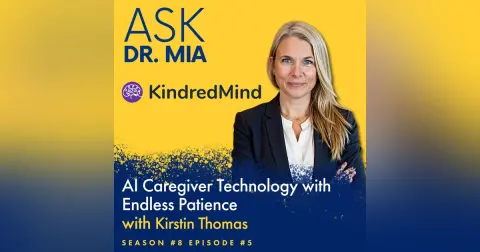
Dr. Mia speaks with Kirstin Thomas, co-founder and president of KindredMind, about how her mother's Alzheimer's and vascular dementia shaped her caregiving journey and inspired a technology companion for people living with dementia. They explain how familiar-voice and face-to-face features aim to ease the anxiety from repetitive calls and support connection, while discussing privacy safeguards, dementia-care principles, and the limits caregivers must learn to accept. Kirstin Thomas is t...

 Apple Podcasts

 RSS Feed

 Spotify

 Goodpods

 YouTube
Dr. Mia speaks with Kirstin Thomas, co-founder and president of KindredMind, about how her mother's Alzheimer's and vascular dementia shaped her caregiving journey and inspired a technology companion for people living with dementia. They explain how familiar-voice and face-to-face features aim to ease the anxiety from repetitive calls and support connection, while discussing privacy safeguards, dementia-care principles, and the limits caregivers must learn to accept.
Kirstin Thomas is the Co-Founder and President of KindredMind. She built it from lived experience: her mother lives with Alzheimer’s and vascular dementia in a memory care facility in Ontario, Canada, and would call again and again, reaching for the comfort and reassurance of a familiar voice Kirstin couldn’t always answer. Unable to find a tool that met that need, she built one, a voice companion that answers a loved one’s calls in the family caregiver’s own voice, grounded in simulated presence therapy and dementia-friendly communication guidelines.
At KindredMind, she leads company strategy, operations, and the brand’s voice, building it as a growing suite of tools supporting people from mild cognitive impairment through the stages of dementia, alongside the families who care for them. Whether answering repetitive calls, offering companionship and conversation to combat loneliness, or carrying reminders through the day, the aim remains the one that started it all: making sure the person living with dementia feels heard and reassured, so caregivers can keep showing up for the people they love, without carrying the weight of every missed call.
Website & Social
https://kindredmind.care/
@kindredmindcare
Chapters
00:00 Introduction
01:00 Kirsten Thomas's caregiving story and the origins of KindredMind
02:56 Early signs: language changes, repetition, and executive function
05:07 A sudden loss of independence and the calls that inspired the product
08:34 How KindredMind Voice offers a familiar, patient response
11:31 AI voice concerns, privacy, and the safeguards Thomas describes
16:01 How call coverage works and options for transparency
19:45 Validation, reassurance, and redirecting repeated questions
22:47 Two voice modes: companionship and reassurance
24:53 KindredMind Presence: tablet-based friendly or familiar faces
28:01 Caregiver guilt, acceptance, and what remains within your control
Video on Ask Dr. Mia YouTube channel
Transcripts on www.miayangmd.com. Transcripts are automatically generated and may contain minor inaccuracies.
Email: ask@miayangmd.com
Opinions expressed are exclusive of Dr. Mia Yang and not reflective of her or guest speaker's employers or funders.
Welcome to Ask Dr. Mia Answers on Dementia Caregiving. I am your pocket geriatrician and memory specialist. When I was helping my mom with her cancer journey, I knew I wanted to be her advocate and her care partner, but I didn't expect to have to rehash old patterns of communication like a teenager. Combining my knowledge as a specialist for older adults and my own experience as a sandwich generation care partner, I am here to empower you to take practical steps to not only care for the older adult in your life, but also take good care of yourself. Welcome. Welcome back to Ask Dr. Mia. I'm excited to talk with you all today with my guest, Kirsten Thomas. She is the co-founder and president of Kindred Mind, and her mother is living with Alzheimer's and vascular dementia in Canada and would call over and over, which inspired her to create what we're going to talk about today, which is Kindred Mind. She has founded other companies, and this is really an experience that's born out of her personal background. So welcome to the podcast, Kirsten.
SPEAKER_00Thanks for having me, Dr. Me. I really appreciate it. I just want to acknowledge before we dive in the important work you're doing to expand access to memory care and to help improve the quality of care through education. So thank you for doing that and creating a platform like this and for having me on.
SPEAKER_01Thank you so much. If you can share with us a little bit kind of what your mom's story is, kind of how your caregiving journey has been. Yeah, of course.
SPEAKER_00I guess just for your listeners, a little context, only child, single mom. So there's inherently a very unique dynamic there. I've always been wired to worry about my mom from a very young age. So I'm hypersensitive to her needs, maybe unnaturally so, but I think that allowed me to be more in tune with the cognitive changes that I saw over time. But I'll also say, just to rewind the times a bit, that my grandmother, her mom, also had Alzheimer's back when I was in high school. So in some ways, I'd already lived this version before. Um that version being specifically the pattern of repetition. As your listeners who are, you know, caring for someone with Alzheimer's or dementia are very well versed in. So that pattern was already familiar to me before I even had language for it. Uh, I would say that I started seeing these cognitive changes in my mom. You know, the rear view mirror is 2020, but maybe even 20 years ago. So a couple decades, where over time she just started substituting words or would even kind of invent words, interchange words. So there was a language deficiency I started picking up on. I also noticed that halfway through some of the stories I would recount for her, whether she lost interest or not, I she just started losing the thread of the conversation. Other things that weren't just what I was noticing is her friends would start reaching out to me and would say, Hey, you know, your mom's been in. And then at the time I would just chalk it up to, or maybe it's denial, but I would chalk it up to aging, hearing impairment, because my mom would ask the same question to her friends a couple of times over, and I would say, Well, she is hard of hearing. So I feel like I was in this mode of finding any other excuse but to accept the fact that she's likely following the same path her mother took. Another kind of clue that I was witnessing is she had sticky notes everywhere. She had many, many notepads. We I used to make several accommodations for her before she lost her driver's license, but we would go and pick up notepads and I would say to her, I'd remark and be like, You have like two already in your purse, and I've seen a few on your kitchen counter. Do we really need another? And she would get a bit defensive. So I wasn't about to get into that with her, but I these were just things that I started noticing. Um, I started helping her fill out her calendar appointments. But typically we always look for, you know, the memory component. But one other thing that I noticed too was decision making. So she knew she wanted to do something, but there was no clear path for her that I could see for even simple tasks like what she used to do automatically, log on to Facebook, I started helping her with. So yeah, just the timeline, that's what I was observing. But it wasn't until April of 2025 where her physician actually reported her to the Ministry of Transportation and suspended her license. So someone who was Uber independent, you know, going to master's gym class three times a week, uh, volunteering, um, all always out and about, uh, running her own errands, now had no means of doing it. So, like I said, those accommodations started, I started filling for her. Um, another clue. And then then we we saw the the TIAs in October, which like textbook just led to a massive stroke. Um and so she literally went from living independently to the hospital, uh stay for a month and directly into assisted living. So it was then those re repetitive phone calls started uh coming in and the repetitive questions. So really, I guess because I have a tech and entrepreneurial background, as does our co co-founder Patrick Armstrong, uh, we were well positioned to solve for this um pain point. And I I didn't want to leave my mom hanging, so we built Kindred Mind, a companion for those living with Alzheimer's and dementia.
SPEAKER_01Thank you so much for walking us through. And I think it's so important for people to recognize that Alzheimer's disease doesn't just show up in the aspect of short-term memory challenges. What you're talking about in terms of the what seems like procrastination or inability to make decisions is that executive functioning that's also very important. In fact, a lot of the literature suggests that it's the loss of executive functioning that is really significant in terms of changing people's level of independence. You know, not being able to drive is a major loss in terms of her independence, even more so than the poor short-term memory, which sometimes there are more ways to compensate versus not being able to sequence or follow multi-step directions, which is really what driving and a lot of the complicated technology aspects require. You say technology, but even following a recipe, my mom was struggling with. Yeah. Yeah. Yeah. It's that multi-step where you have to time and you know, I should do this and then do that, and I have to wait for the oven to heat up. And before the oven heats up, I need to do these things. That that actually takes a lot of planning that I think we all do somewhat naturally. Yeah. Unless you're really not someone who cook. But yeah, no, and then and then I actually was just talking to a patient of mine recently where this person also has a very language uh variant of Alzheimer's disease. And that is also very underrecognized, kind of out in the community as well, where it almost seems like someone has had a stroke, but they never had a stroke. They just have trouble completing their symptoms or sw switch out words.
SPEAKER_00Mm-hmm. Yeah. Uh they they the clinical term I think is aphasia. And I'm only coming to understand a lot of it now with you know some of the the readings that I've done to better understand um my mom's progression to where she's at now. But yeah, I mean, like I said, the rear view mirror, looking back, I it was the language actually was was a big clue for for me.
SPEAKER_01Yeah. Yeah. Yeah. Well, tell us a little bit about Kindred Mind. What is it intended to do? I know there are different versions of it. Yeah, yeah, sure.
SPEAKER_00Thanks. So Kindred Mind is a companion for people living with dementia and Alzheimer's. It's powered by technology and it learns to sound and respond like the family caregiver. So we're leaning on familiar voice technology. I'm gonna speak about the voice component because, as you mentioned, there's several products. So we'll we'll start with that. But I also always want to say that I visit my mom almost every day and I field as many calls as I can. So this is not a replacement for humans or for family caregiving or professional caregiving for that matter, but rather a bridge for those moments you just can't be there. So it was those calls for me that really that I couldn't get to that really weighed heavily on me. The pivotal moment for me was when I was at my daughter's dance recital and I had to ultimately choose between watching my daughter step on stage and feel that call for my mom. And it was in that moment I'm like, how can I be in two places at once? So that is what kindred mine is, the voice components. So as mentioned, it will, it will take my airtime. So my my voice, and it will answer those calls that I can't get to in my voice based on a bed of knowledge that I share. So when I physically can't get there, she hears a warm, patient, unhurried voice in mine, and it's all trained on the validation model, which is, as you know, the clinical standard for dementia care since the 60s. And it also, our pillars are based on the Alzheimer's Society of Canada's guidelines for dementia-friendly calls. So, what all that means is it will never argue with her, it'll meet her where she's at. It doesn't correct her. Um, it really meets her need, and that need being to be heard to and to hear someone that is her trusted person, that being me. So the conversations are never generic. It's not a recording, it's it's not scripted. They're, as I mentioned, built on relevant information that I share. So if she calls and she asks after the kids, now she no longer can address them by name, but she knows there's grandkids to ask after. I can say, you know, Caden just accepted a co-op job while in his final year of uni, or that Owen applied for, you know, a big brother position, or that Annika scored a perfect 100% on her geography test. Whatever I want to share, it will have that conversation with her. So it's like mentioned, not generic and grounded entirely in the details that I share. So none, no, no personal identifying information, no last names, no addresses, no medical, financial, all of that. It's just very surface level, but enough to have a very rich conversation based in her world and the rhythms of her day. I can, I can, I can go on to the other. Yeah.
SPEAKER_01Yeah, yeah. Let me ask you a quick question about Kendra Mind voice. So this is using AI to take the relevant information. I know there's a little recording that a family caregiver will do. And then the AI uses this information generating a voice that is similar to your voice. I know we we talked before this recording just a little bit about um we all have some understandable hesitancy in terms of using AI and how to use the AI for good. Um I appreciate you mentioning the fact that there's no sensitive information that is kept or recorded on Kindred Mine. How do you what do you suggest in terms of people who are hesitant to have a voice that sounds like them? Um, because it is it is a little bit of a deception to say. Oh, for sure. I'm not the one answering, but it's my AI Dr. Mia answering the call.
SPEAKER_00So I'll I'll answer this in two parts. One being when I was looking to see what was available to answer those calls that I couldn't get to. I mean, I was receiving, you know, upwards of 10 calls before lunch. And, you know, I'm running after my kids. I have a I have a career, I have a house to run myself. So while I wanted to answer all of those calls to ensure that my mom wasn't sitting in anxiety or fear, because as we know clinically, that there is the separation anxiety component. And I didn't want that to compound with all of the unanswered calls. So what I was looking for was an option. And there, what I what I found were, you know, simply blocking the call, silencing the call, sending the calls to voicemail, um, or some people remove the call, the phone entirely from their loved one, which, you know, goes actually against the ethical principles of dementia care because you're removing their independence unnecessarily so. And then some people medicate that anxiety. All of these options didn't uh didn't work for me. And I knew that I could figure another way out. So back to your question about, I guess, marrying technology and a vulnerable population. This is this is someone's mom, and this is my mom, or someone's father, or in some cases someone's spouse. So it we don't treat this lightly. If we weren't being careful with that, I'd be the first one to raise the alarm. So what we've done is every call transcript is encrypted with AES-256. It's very technical, but um, before it's stored. And it's actually the same standard governments, banks, and hospitals use. It's an actual industry standard, uh, and it's not a marketing line. This is extremely difficult to crack. So AES stands for Advanced Encryption Standard, and the 256 refers to the length of the encryption, so that's 256 bits. We don't keep it forever. The transcripts are auto-deleted after 90 days. We're not trying to build a permanent archive of these conversations. It's just a little window opportunity for the family care person to come in and review the transcripts, get the Coles notes version of the affect and if there's any call to action, but they are deleted and so that you're also never out of the know. You're always in the know, never disconnected. We don't record the audio. So back to your point about the onboarding. So, yes, the caregiver will have, it's actually now down to eight seconds, an eight second an eight-second uh audio clip of you that as the caregiver offering kind of the same tone you would use with your loved one, you know, may differ from the one you use with a friend, for example. So we we encourage you to use that similar tone uh so that it can't captures that nuance. And then, of course, you you add to the dashboard that information so that it can draw upon that information when having those conversations. But that initial audio recording is deleted also. So the only thing that lives in your account is the information that you share, your consent, and then the reproduction, the recreation of your voice. Um, we don't share with third parties. We only collect what is required. As mentioned, we don't ask for last names or addresses or financial, medical, all of that. It's like I said, very superficial. We only ask for what is pertinent and necessary to set up the account. Yeah, and we also don't pull anything from our devices, the for from the care person's devices or or contacts. So it's pretty bulletproof that way. I've thought of or we've tried to think of everything because again, the reason for this is my mom. So I'm I'm coming from this from a place of what would what would I want from my mom.
SPEAKER_01Right. So in your case, or from a sandwich generation caregivers case, they would basically set up this technology on their phone, and that when their loved one calls them, the AI technology or Kendra Mime Bridge will come kind of answer on behalf of you.
SPEAKER_00So how it works is yeah, the the loved one never needs to interface with the tech at all. It's really set up by the sandwich gen, the older child or spouse, uh, whoever is the caregiver. And um you do it through, as I mentioned, this dashboard on a web browser in our app, and then it generates a unique dedicated Kindred Mind phone number. So what you then do is you go to your loved one, in this case my mother, she has one of those now. She had a cell phone, so I had it on her cell, but she's graduated to a big button phone. And beneath my picture on that big button phone, I've programmed that Kindred Mind number so that when she calls, she can either directly reach me on my cell if my mode is available. But if my mode is to cover for me in the event I'm in a podcast with you, you know, or it's 2 a.m. and I'm sleeping, then I have it toggled to cover for me and it will go directly to Kindred Mine and answer her call in my voice and have a conversation with her and answer all of those, you know, repetitive questions, those questions of concern. Oftentimes she wants to know when I'm coming to see her, again, how the kids are doing. So because I've I keep it fair, I try to keep it very updated, almost on the daily. That's not necessary because, you know, she may not even remember the conversation she had five minutes ago. As per UCLA, it's true. Five minutes is kind of the the time frame of when the memory fades due to the short-term memory. But uh I I try to keep it updated and relevant so that when she does call with those repetitive questions, that at least it kind of iterates upon them. Yeah, yeah.
SPEAKER_01And that that's really exciting in the sense that people can get a voice that's similar to you. And I know that there's also the option to not use your own voice if you prefer not to sort of setting up an assistant.
SPEAKER_00Yeah, absolutely. So there's with the with the advent of AI and tech, I I can appreciate how some people may not want to have their voice cloned or have it, you know, out there. But so I can also say that all of us are online now. So you can easily with 30 seconds of audio uh recreate it. I know. But I mean you can also have the option uh to have an like I quote unquote assistant or a friend or a neighbor, whomever you want to. And, you know, for mild cognitive impairment at the beginning of the dementia journey, you can be fully transparent and say, hey, listen, mom, I am in meetings all day. I'm not gonna be able to get to your call. I'd love to, but I I can't, and I'll try. But in the event I can't, I have an assistant that is AI that can answer those calls for you. And I've I've populated it with all the information it needs and has. So in the event you have a question, it'll be able to answer. Now, moving along the journey, as we know you get into you know, mid to to moderate to end stage dementia, you can still very well be transparent, but can they hold on to that memory? We we know the answer is no. Could they even make an informed decision again? Or do they understand, you know, what AI is? So really it's built to uh meet the need and to reassure them. So it's it's the end goal is to bring that loved one to a place of calm. So it's it's yeah.
SPEAKER_01And I think even real life caregivers want to know what to say. I think that's such a common question for for my patients. And sometimes, you know, no one, unless you're AI uh machine, have an endless amount of patience kind of saying the same things over and over. That's a great use of technology to repeat. Over and over.
SPEAKER_00Absolutely. I mean, Kindred Mind does not get frustrated. Kindred Mind has very strict guardrails, and as mentioned, it follows, you know, it has it's built on strong pillars from the Alzheimer's Society of Canada, the validation model, simulated presence therapy. So all of that is tightly woven in. And they it will never sound irritated. It will never say, hey, you know, this is the fourth time you've you've asked me this question. So instead, it just it's gentle. And really, it's it's the whole goal is again to bring that agitation or that sense of fear or concern back and redirect it to a place of calm. So in the case of my mom, if she calls and she feels that I haven't visited her ever, even though I'm there almost every day, I could literally leave having visited her, return to my desk, and she'll call and say, When are you gonna come see me? So that kindred mind can then, instead of correcting and saying, Hey, I was just there five minutes ago, give me a chance to breathe. It will say, Absolutely, I'm looking forward to seeing you. I look, I'll be there and I'll have already provided that detail as to my next visit time. In the meantime, so it's validating that, you know, of course we want to connect and be together. Then it will reassure and say, we will be, and then redirect to a place of something that kindred mine knows she's interested in, gardening or her next meal time or her girlfriends in the common area. So it will, it will go through that kind of process to, again, for the goal to bring her to a place of calm and reduce that level of agitation. And there's been clinical, there have been clinical studies on this where they actually instead of using, of course, because this is now the advent of technology, but instead of using two-way generative communication, they had a recording of a family member in a nursing home. And what they noticed with the resident was they were agitated, asking after their family member. And so they played a recording and noticed physiological reduction in anxiety, in agitation. And so we're just catapulting this same model. into you know our new age where we can now have it interact and have a two-way conversation.
SPEAKER_01That's really exciting. And I think for for caregivers who want to know exactly what Kendra Mine said, they can look at the transcript and say, I I can say, well, let's talk about, I don't know, your gardening next time or or what what music you're listening to, which is oftentimes difficult for people to think of right at the top of their mind when they're already frustrated by, you know, the fifth or the sixth call that that morning. Yes. Yes. Transitioning a little bit, um, can you tell us a little bit about Kendremind presence and and how that is different from the voice?
SPEAKER_00Yeah, yeah. So um I will say that one at one extra thing I wanted to add about the voice component is there are two offerings. One for the MCI, which is the mild cognitive impairment phase. And then as mentioned once you get um down the the progression of the cognitive decline. So the initial voice is really meant to stimulate the mind, to exercise the language skills, to really offer companionship. The National Institute of aging links loneliness up to a 31% higher risk of developing dementia. So the conversation for the early stages of cognitive changes is really meant to jog memories, to chat about interests, and to offer that companionship that is not the familiar voice. That would be a friendly voice. So you could you could set it up for your loved one and and and say hey I know your afternoons might get a little empty of course you're going to say it the way it sounds comforting to your loved one but I have this idea and I have you know you can you there's actually I can't remember now but we have several female female voices several male voices different accents and and tone tonalities and they can go through it and select one that, you know, appealed to them and have conversations with them on a whim you know and even if they have trouble sleeping it can be at two o'clock in the morning where they can have these stimulating conversations. So that just to wrap up the voice component two offerings completely different goals in mind one is to combat loneliness and to exercise language and and and cognition while the other one is really about reassurance. It's really, you know, once you are later in the stage it's really about offering that kind of security and that familiar voice. So now back to presence and sorry if I'm long-winded we've no worries we've also built um a face-to-face version of that companion since having a face to talk to especially earlier in the disease changes how like present the interaction feels so the experience can adapt depending on where someone is again in their memory journey. For some experiencing early memory changes, presence offers a friendly face. So it's not a familiar one it would just be again, you know, a neighbor or just a kind person to talk to where again their their conversation is unhurried. It's very stimulating it's really meant for mental engagement. So the difference here between the voice and the presence is that you have a face also to talk to and for someone living with dementia that are that is full, you know, moderate dementia and again with permission from the the family caregiver, using a face and voice that the person knows. So that would be leaning on the familiar simulated presence therapy to bring reassurance and familiarity to that conversation.
SPEAKER_01So potentially the the person with dementia would have this friendly face on a tablet and then they just start talking to this friendly face and the caregiver will set up this friendly person using like their own picture or someone who can exactly it's on a tablet.
SPEAKER_00So the family caregiver if it's if it's in the early stages you can sit down with your loved one and select a friendly face that you want to have endless conversations with stimulating conversations with it's up to the family caregiver and that loved one to input all of the information into the knowledge base. So if they enjoy you know discussing politics or if they enjoy you know funny jokes or or reminiscing or you know about personal family memories or you know talking about music and hearing their favorite songs actually play all of that can be added to the dashboard to the knowledge base so that when that loved one taps the face on the tablet they come to life they know everything that this loved one wants to chat about stories that they'd love to hear because it's all built on the knowledge base. Now fast forward down the the the dementia journey it would now be again a familiar face of course you have the option of a friendly one but in this case because of the reassurance and the the uh separation anxiety component a familiar face studies have shown to work best at reducing that agitation, that the the fear and anxiety. So you would have again you what you do is upload a photo of yourself, offer 30 seconds of your voice, populate the dashboard with information that you know your loved one would enjoy talking about or even hearing about because as we know some people lose their language skills altogether but they can still you know enjoy music or enjoy stories or enjoy you know reminiscing about memories. So your loved one will watch you and have this conversation with them or or just listen to stories that they want to share. So they feel again in in the same company as as their loved one and it's just a simple tap on on the the tablet that brings it to life.
SPEAKER_01That's really exciting. That's really crazy how much the technology has advanced with the advent of AI. I'm wondering going out of the tech and and kindred mine or maybe involving kindred mine is there anything that that you felt like you wish you had learned earlier in the caregiving journey?
SPEAKER_00Yeah I wish I had understood earlier that I can't fix everything or try or try to fix everything. But even now I'm still kind of reconciling that for myself you know wanting to make things better for my mom. I still struggle with the guilt uh of the calls that I can't get or you know the day that I don't go to see her. But I think in answer to your question, it's understanding that a good caregiver doesn't mean that you're available every single minute of the day. But knowing that and accepting that for me are I'm still reconciling. So yeah, I'm still in the thick of it it's still hard it's still raw it's a work in it's a work in progress but I guess in as it like if I were to answer this, I can't control the outcome especially with someone like my mother who has vascular and Alzheimer's vascular dementia and Alzheimer's so I'm learning that I can't fix that. That's my mom's path but what I can control is how she experiences her day to day now. You know I can make sure her dignity is preserved uh that she's clean that she is comfortable that she's cozy that she's safe all of those things I can make sure that she has mental and physical stimulation when when she welcomes and and wants to participate and I, you know, those those are those are important those are important things for me and and I think most importantly is I can I can make sure that she feels love when we are connected. So I guess the the the essence of that long-winded answer is that I have to accept that I cannot change her course but what I can control is how she enjoys her day to day.
SPEAKER_01Yeah and that's so beautifully stated because I think acceptance is so difficult and I think we continually it it's a double-edged sword because of the drive to want to make things better is kind of what inspired you to create Kindred mind and I'm sure all the other things that you're doing to optimize your mom's quality of life but also that drive is part of the guilt and you know it's never it's never good enough because we are not able to be a hundred percent available and and we can't change the ultimate outcome which is which is really difficult for for many, many families. So I appreciate you sharing that and being vulnerable about your own journey and of course creating this technology that I'm hoping is helpful for other families. And I appreciate you coming on to the podcast today. Any last words or anything else you want to mention where to find you or Kindred Mind. And we'll include this information in the in the um episode notes as well.
SPEAKER_00Yeah thanks kindredmind.care and on all socials thank you so much.
SPEAKER_01Thank you so much Kirsten Thank you so much for listening to this episode please click the follow button on your favorite podcast platform. Please remember that this is educational content and that do talk to your own doctor if you have specific questions. Original music by Grant Willis and the podcast is edited by Builder Liberian. And finally please repeat after me by taking care of myself I can better care for the older adult in my life