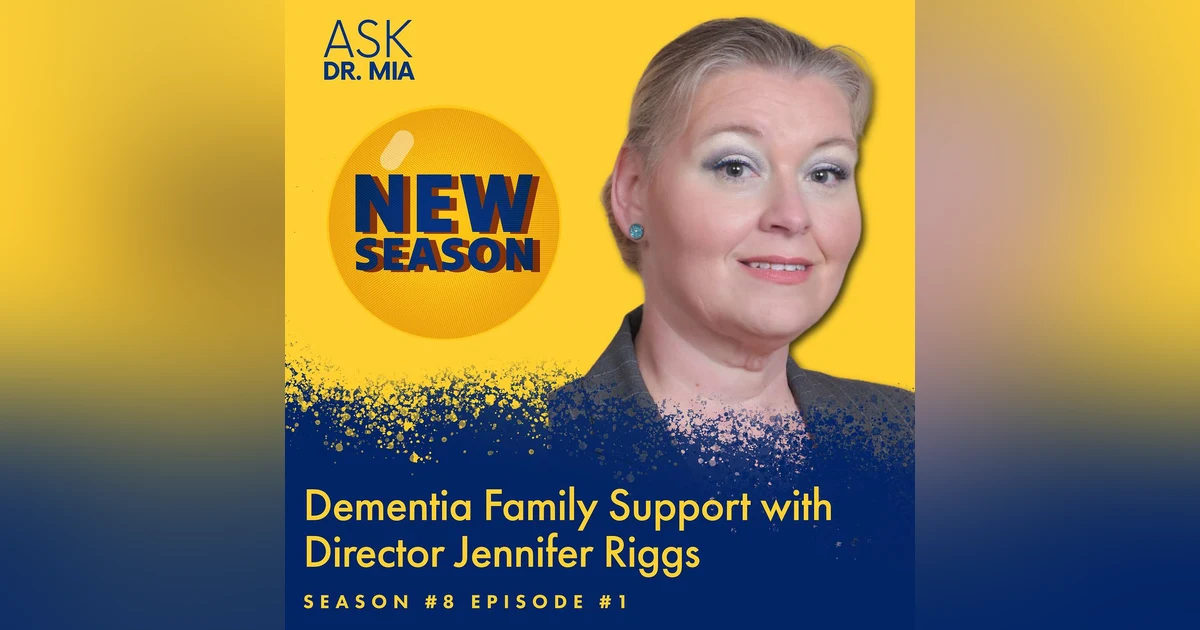
Dementia Family Support with Director Jennifer Riggs

Send us Fan Mail Season 8 kicks off with Dr. Mia interviewing Jennifer Riggs, a caregiver and dementia care expert, about her personal journey caring for her father with dementia and the practical techniques she has learned to support individuals with dementia and their caregivers. Jennifer Riggs is the Director of Dementia Services at Dementia Family Support, a Certified Dementia Practitioner, and a Positive Approach to Care (PAC) Certified Trainer, Consultant, and Coach. She has spent her c...

 Apple Podcasts
 RSS Feed
 Spotify
 Goodpods
 YouTube
 Season 8 kicks off with Dr. Mia interviewing Jennifer Riggs, a caregiver and dementia care expert, about her personal journey caring for her father with dementia and the practical techniques she has learned to support individuals with dementia and their caregivers.
Jennifer Riggs is the Director of Dementia Services at Dementia Family Support, a Certified Dementia Practitioner, and a Positive Approach to Care (PAC) Certified Trainer, Consultant, and Coach. She has spent her career helping individuals living with dementia, family caregivers, and care professionals navigate the challenges of dementia with practical, compassionate, person centered strategies. Her work is also deeply personal, as she cared for her father through his journey with vascular and Alzheimer's dementia.
Chapters
00:00 Intro to Season 8
03:00 Introduction to Jen Riggs and her background
04:20 Jen shares her personal experience caring for her father with dementia
05:30 Emotional challenges of caregiving and staying emotionally sane
07:40 Making decisions in medical care with a focus on quality of life
11:29 Learning from Teepa Snow's dementia care techniques
14:05 Practical tips from Teepa Snow's approach, including visual support
16:08 The hand under hand technique and its benefits
18:00 The importance of giving dementia patients a sense of control
19:39 Understanding communication as expression rather than behavior
20:33 Dementia Family Support and caregiver education services
23:35 The importance of understanding the disease and building a support village
25:37 Final thoughts and resources for caregivers
Video on Ask Dr. Mia YouTube channel
Transcripts on www.miayangmd.com. Transcripts are automatically generated and may contain minor inaccuracies.
Email: ask@miayangmd.com
Opinions expressed are exclusive of Dr. Mia Yang and not reflective of her or guest speaker's employers or funders.
Welcome to Ask Dr. Mia Answers on Dementia Caregiving. I am your pocket geriatrician and memory specialist. When I was helping my mom with her cancer journey, I knew I wanted to be her advocate and her care partner, but I didn't expect to have to rehash old patterns of communication like a teenager. Combining my knowledge as a specialist for older adults and my own experience as a sandwich generation care partner, I am here to empower you to take practical steps to not only care for the older adult in your life, but also take good care of yourself. Welcome. Welcome back to season eight of Ask Dr. Mia podcast. I am excited to share my ideas with you listeners about this particular season and also reflect on the past four years of doing this podcast as I started in 2022. Going through my mom's cancer diagnosis as her care partner really galvanized me to start this podcast because the experience of being a sandwich generation caregiver, even though at times I did not identify with the word caregiver, made me realize how many other people are going through similar things. Although I am not a cancer specialist, I am a memory specialist, and I know so many of you are struggling with similar things. I want this particular season to particularly hone in on my expertise as a geriatrician, a memory specialist who've taken care of patients in all kinds of settings and have the research and educational background to translate this information that is oftentimes very limited in terms of medical expertise to the wider public so that you don't necessarily have to come into my clinic to be my patient to receive similar quality of information. With the advent of artificial intelligence, or even before then, the amount of information that is out there about Alzheimer's disease and dementia is a lot to digest. But I think what I could offer to you is really nuanced healthcare navigation so that you can best help your loved ones navigate the healthcare system, identify diagnoses, and sort through how to coordinate care. As my personal experience has shown me, a lot of this people are doing on their own, and it can feel really quite alone. It is my goal with Ask Dr. Mia navigating dementia caregiving to provide you with the information and the confidence to navigate everything that is happening around you a little bit better. I hope you enjoyed this season, and please let me know what resonates with you by sharing a review of the podcast or contact me directly via my website at MiaYangmd.com. Thank you. Welcome back to Ask Dr. Mia Podcast, and we are excited to kick off season eight for this podcast that I started in 2022, and I'm excited to bring to you my guest today, Jen Riggs. Jen is the director of dementia services at Dementia Family Support, and she was a caregiver for her father on his journey through vascular and Alzheimer's dementia. That journey has really led to her work now as career supporting individuals living with dementia and their family caregivers with practical and compassionate patient-centered strategies. She has a number of certifications, a certified dementia practitioner and a positive approach to care certified trainer. And I welcome Jen to the podcast. Thank you for joining us, Jen. I know that a lot of my listeners are sandwich generation caregivers and are trying to do all the things in terms of supporting their aging parents as well as managing their life and kids. If you can get started and just share a little bit about your experience in caring for your dad.
SPEAKER_01Absolutely. When I first actually came into the dementia journey, I never thought it was going to hit so close to home. We didn't have anybody in our family that had any signs or symptoms. I just was in an assistant living and had so many residents that had this word dementia associated with their, you know, journey. And so I started studying it. And lo and behold, my own father wound up being diagnosed with vascular and Alzheimer's dementia. And I was so thankful that I had the education to support him, but nobody could prepare me for the emotional journey that was going to take place, advocating for him, understanding what was going on medically as well as emotionally for him. And I do thank him. You know, unfortunately, he did pass away a little over two years ago, but I thank him for allowing me to walk aside him and be able to be his advocate and learn so much through his own, you know, dealings with this word dementia.
SPEAKER_00Yeah, thank you so much for sharing. That actually really mirrors a lot of the my own personal experience as well. So my mom did not have dementia, but she did have ovarian cancer, also passed away about two years ago. And, you know, as a physician, you know, I knew about kind of the medical aspect of things, but the emotional aspect of now being a care partner or caregiver really was surprising to me as well. Um, I'm just wondering, like, what how did you manage, you know, staying emotionally sane and relatively calm at that time?
SPEAKER_01Some days it was very hard. At the time, I thankfully I worked for an elder law firm who was so understanding of the journey, considering that they were life care planning specialists who had social workers and all of these levels of support. And they were supporting my father as well as, you know, being my employer. But at times it was daunting. And, you know, sometimes I feel like I even had to disassociate as the daughter and kind of think as the professional and being able to, you know, stay neutral and not allow my own perspective as, you know, the adult daughter to cloud my judgment on what was best for him. And, you know, I wish I could say our, you know, relationship didn't have its hiccups or, you know, turmoil at times. But at the same, I was able to put that aside and just be able to put his needs at the forefront and remember that, you know, that was really the goal was to have a quality of life for him.
SPEAKER_00Yeah, that's really important. And it's so hard to separate when we wear multiple hats, you know, as a professional, as a daughter, as a, you know, wife, mother, and and lots of other hats, friend. What what I don't know if you can talk about like what would be an example where that sticks in your mind, where you felt like you kind of had to make a conscious effort to kind of think about your dad's needs, which may have been different from yours.
SPEAKER_01Yep. So honestly, it had a lot to do with his journey. Unfortunately, he was a type two diabetic and he wound up getting a septic wound. And, you know, I'm a big component for hospice services. So we were on hospice and palliative support. And then, you know, he got the septic wound, and it was okay, you know, what is going to be able to meet his needs? So we did discharge to the hospital. And when we were there, it was a lot of conversations about what treatment plan we were going to do. And at one point, the thought process was, you know, do we amputate? And for my dad, that would mean, you know, being non-weight bearing for six to eight weeks and relearning how to walk with a cognitive impairment. And I really had to disassociate because the daughter in me wanted to do everything to buy more time for him and for me. But the professional and the person that understood the disease and what that journey was really going to look like as far as a quality of life, I had to put his well-being at the forefront. So we made decisions that were able to treat but not cure, and return to as much of a, you know, a base of, you know, quality of life for him. And so we didn't amputate. We went in and did um, you know, debrieve the wound as best as we could and went back to really just supportive measures and, you know, being able to keep him comfortable for the remainder of his life, which wound up being, you know, only about another eight more months. But in the time being, we did, you know, celebrate. We went to his old stomping grounds in Vermont and had, you know, a bucket list trip and just made sure that he felt as as happy as we could.
SPEAKER_00Yeah. And that's really hard when when we as dairy care partners would have made a different decision if we were the ones, but having to account for what our loved ones would want. And in your in your dad's case, you know, I think not doing that debris man was really important for him and his quality of life. And I think in in my mom's case, it was really about the decision to kind of stop doing chemotherapy. There were certainly more options that I think I would have probably wanted, but it wasn't something that she wanted. She really felt like her quality of life was not acceptable at in terms of continuing to get chemo. And and I think as healthcare professionals, in some ways, that actually that aspect helps a little bit in terms of just knowing that it's not giving up, like if we choose a less aggressive measure, but it can be really hard for other families that have encounter encountered to like not interpret that more conservative measure as a giving up of something.
SPEAKER_01Yeah. And I that's, I think, is a big lesson to learn is you know, not giving up, but remembering, you know, what is truly going to support the person and give them that quality and and wholeness as best as you can. Absolutely.
SPEAKER_00Um, I want to transition a little bit to kind of talking about your experience getting Teepa Snow's training. So for those who don't already know about Teepa Snow, go find her on YouTube and she's got training sessions for caregivers as well, as well as for healthcare professionals. Teepa is an occupational therapist who has just a tremendous amount of uh tips for caregivers. I think one of the things that I learned about is really just kind of her method of approaching a person with dementia, you know, and approaching them in a non-confrontational way, um, being careful of our body language, our body positioning, the tone that we're using, all of the things that it's common sense when you when someone points it out, but sometimes we forget and don't realize that we're maybe agitating around, you know, accidentally agitating a person with dementia just by the way that we we present ourselves. So yeah, Jen, what what has been your experience in terms of learning from TIPA? Absolutely.
SPEAKER_01I really think that, you know, she was a game changer for me and really was able to fill in some of the void that I had. You know, at that time it was, you know, more my profession, and I was a certified uh CDP, certified dementia practitioner, and I was a facilitator for a support group. And that's when I stumbled upon Teepa Snow, and it was just so relatable that the people that I was working with really kind of opened up and accepted the things that she was saying. And then I started this journey with my dad, and I went down and became a, you know, certified through our community. And I felt like it was actual techniques, you know, all these conversations before were talking about personal-centered care and, you know, putting the person first and, you know, respecting their wishes and giving them dignity, but it didn't tell you how to actually do that. And then it was Tipa and her PAC community that said, there's positive physical approach, there's supportive communication, there's hand under hand, that was really something that you could hold on to. And at first, I'll have to say, I was like, okay, this sounds like it could work. And then when I went home and started using it, and I was like, wow, she really knows what she's talking about. And it changed the dynamics so much that I became such a believer that I wanted more people to experience it and to understand and be able to have these tools in their toolbox to support their loved one that they were working with.
SPEAKER_00Yeah, what would be like a practical tip that our listeners could do like immediately in terms of what you have learned from Tipa? I know there's a lot to cover, but what kind of sticks out in your mind that when you learn you're like an implement it, you're like, wow, this is amazing.
SPEAKER_01So it's hard to pick just one, but I think I'll I'll kind of echo what you were saying with the approach. You know, we don't talk enough about the visual changes that come along with brain change. But the truth is for somebody who's going through this dementia journey, their world narrows in quite dramatically. And for most people that are diagnosed, they're in what we call binocular vision. And when you talk about binocular vision, that when you try to be supportive, if you come and square off with somebody in a binocular vision, you're taking up their whole visual window. And just by kind of pushing your shoulder back and giving a visual window past you, you go from being confrontational to supportive. And just that little tweak can start an interaction in a positive way rather than igniting that amygdala that kind of puts them in that survival mode. And, you know, a lot of times evolves to what we call behaviors. And the truth is it's just somebody who felt overwhelmed by just that little change of, you know, hey, I want to be here with you, but I want you to feel like I'm I'm not the whole entirety of your world. And I am a care partner rather than a caregiver.
SPEAKER_00Yeah. I love that the the distinction between care partner and that it it honors kind of the the humanity of the person that we're caring for, and that they're they are not the just the recipients of our care, although in many ways, you know, there there seems to be a power dynamic at play when we use the word caregiver versus a more equal power dynamic when we use the word care partner. I wonder if you can also share a little with the audience just about what is hand under hand. Um I know Tipa talks about it, but for those who are not familiar, absolutely.
SPEAKER_01So it's funny. I I do training and I try I train a lot of caregivers in this technique. And going from what is very familiar, which is a handshake, but unfortunately with a traditional handshake, as somebody progresses, they might keep strength, but not skill. And strength means that they're gonna hold on and may potentially put you at risk. So instead, you kind of slide up and make this butterfly. And because we want to give the empowerment back to the person with the diagnosis, we let them lead by being on top, even though we can still do a lot of care and a lot of support, but just that overall feeling of you are in the driver's seat and I'm here to help you. So you go from this handshake to hand under hand. So the care partner with the healthy brain is the one underneath, and the person living with dementia is the one on top. And what you can do is you anchor with your ring finger and your pinky, but it leaves your skill fingers free that you can provide physical support from everything from dressing to you know, feeding assistance to just comfort measures from this standpoint. And we're doing it together. So there's motor memory, there's emotional connection, um, there's even some metabolic, you know, support because your body will release cortisol, which actually kind of connects at not cortisol, I'm sorry, the connection hormone that actually connects you and bonds you with the person that you're you're connecting with. And so there is an internal connection that's made that really has these great outcomes in providing physical assistance.
SPEAKER_00That's fantastic. And I love that you have a hand model just like on your desk. So for for for this episode, it would be helpful to watch us on YouTube or I know Apple Podcasts has also recently started doing video podcasts. So to take a look at uh take a look at Jen's hand position if you were just listening to us by audio. So yeah, to echo what you have said, Jen, I think so much of this is about giving people with dementia some sense of control when so much of their world is sort of being taken from them and things that they used to do are not able to be done or were taken away because of concerns for safety. Just even the the the way of kind of holding them and holding their hand gives them that sense of control that they're still in charge of something, which I think as humans we all want to have a sense of control, and it's very distressing to not be in control and feel like we have no no agency over our lives. And and so much of what we call behaviors is really just I think of it as human reactions to I'll met need that, you know, whether it's boredom or overstimulation or you know, the need to move, need for engagement, a lot of things that I think it's really, really challenging for family members to provide, but but make sense in terms of what the the person living with the disease is kind of expressing in ways that they're no longer able to express verbally. Absolutely.
SPEAKER_01And I think that's the you hit the nail on the head. It's it's expression. You know, that's our biggest thing is, you know, we like to label it as behaviors, but the truth is it's communication. And, you know, verbal communication is a skill that a lot of people with cognitive impairment, it's one of the first things that starts to be altered. And so we have to learn to listen with our eyes and listen with our heart and listen in a way that, you know, gets to the underlying emotion rather than the outward projection of what they're doing so that we can be responsive rather than reactionary.
SPEAKER_00Yeah, absolutely. And to transition a little bit again, I know you are part of Dementia Family Support, and I'll put the link to the website in the show notes, but can you tell us a little bit about what you guys do within dementia care support? Absolutely.
SPEAKER_01So it's really personable to you know what your journey needs. So for some families, I do education, and for other families, I do coaching on a regular basis. I also work in the professional realm with going in and training line staff employees to be able to utilize these techniques like positive physical approach and hand under hand and really understanding what's going on behind the scenes and the changing of the brain so that you can look for in this moment what is being expressed and what is being, you know, a kind of you know sorry, uh that what is kind of being communicated as far as the underlying need. And so, you know, I'm I'm able to kind of walk that journey so nobody feels alone. And the other side of this is that sometimes I'm just an ear to listen to because you know what? Sometimes you need somebody that's safe to say this isn't fair, this isn't what I saw for my loved one or I saw for myself as the care partner. And that, you know, it's okay to have, you know, those emotions and to remember that any bad moment is just that a moment of time, and that we get to take a time out, breathe, regenerate, re-reinvigorate ourselves, and go and do it again, and hopefully do it in a way that gives mutual benefit to both sides of that care partnering.
SPEAKER_00Absolutely. And I know you have a ton of like workshops and caregiver educational offerings online as well. Some of them are series and some of them are a little bit sort of a one-off type of thing. What kind of what kind of things do you teach uh caregivers to do within within these more of a group setting?
SPEAKER_01So it really depends on the workshop, but the foundation is again understanding of the disease. You know, unfortunately, I I even learned this as you know, somebody walking the journey with my dad that you get handed the diagnosis, but not the playbook of what's going to come down the road. And the other side of this is that it's so unique from person to person. And even just the word dementia is so broad and so sometimes misleading. You know, people think that that's the actual diagnosis, but the truth is Alzheimer's or vascular, Lewy bodies, you know, the list goes on and on for over 120 different diagnoses that fall under this umbrella. And so to really understand what we're going through and how to work through the hurdles that come and how to be that partner rather than, you know, kind of putting your head on the wall and giving up.
SPEAKER_00Yeah, absolutely. Well, I see that one of the sessions is about, you know, communication, which is, I think, always a challenge in terms of family caregivers or professional care caregivers and the person living with the disease. Any practical tips that you could share? Obviously, you know, go go attend Jen's actual communication workshop, but just for the audience here that you think would be helpful for people to know? Absolutely.
SPEAKER_01The biggest thing I can say is be the mirror, be reflective. What you are hearing, what you are seeing, you need to kind of express that back to say, I get it. I'm here with you. I'm listening. So when you see somebody who is angry, you know, being able to be that mirror and say, I see that you're really angry. I'm sorry you're angry. Let's work through this rather than trying to be logical and try to de-escalate with a lot of words and a lot of concepts, but just being in the moment and reflecting what you see can be a big game changer. Are you there? I think I'm a little delayed.
SPEAKER_00Thank you. Thank you, Jen. As we kind of come to the conclusion of this episode, anything else that you want to share with the audience that we haven't already mentioned?
SPEAKER_01Don't try to do this alone. You need a village. And I know that kind of sounds a little cliche, but the truth is, is this disease is too heavy for any one person to carry alone. So you need to have a support system, whether that is a strong family support system, a strong friend support system, or professional support system, or a little bit of all of the three that I mentioned. Build your village so that you don't go through this and feel like nobody else is listening or understanding or is there to help you when you struggle.
SPEAKER_00Thank you so much, Jen, for joining us. And thank you for all the tips that you have offered to our audience. I really appreciate you all for listening. And that more to come on this season of Ask Dr. Mia. I will be doing additional insights about anti-amyloid drugs as well as my impressions from the recent Alzheimer's Association International Conference. Please hit follow on your podcast player and always let me know if there are any topics you would like for me to cover. Thank you and talk to you next time. Thank you so much for listening to this episode. Please click the follow button on your favorite podcast platform. Please remember that this is educational content and that do talk to your own doctor if you have specific questions. Original music by Grant Willis. The podcast is edited by Builder Liberian. And finally, please repeat after me by taking care of myself, I can better care for the older adult in my life.