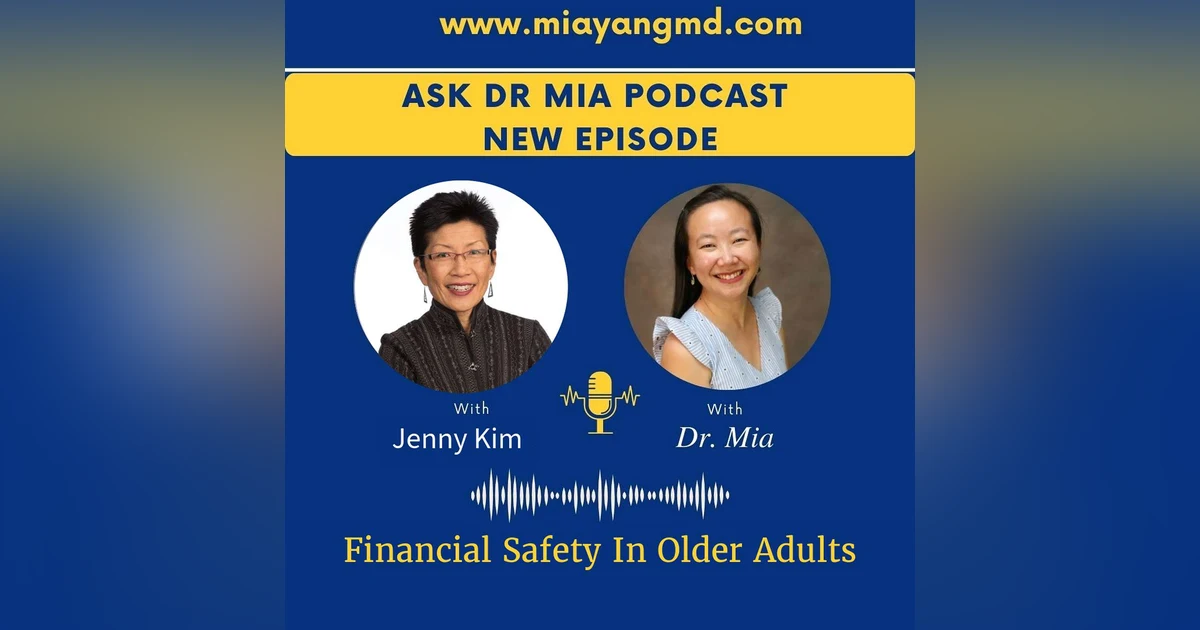
37. Financial Safety In Older Adults


 Apple Podcasts

 RSS Feed

 Spotify

 Goodpods

 YouTube
Summary
Jenny Kim, a family caregiver for her elderly parents, shares her experience managing their finances and healthcare. Her father, who has severe dementia, insists on withdrawing large amounts of cash and giving it away. Jenny has power of attorney but faces challenges with banks and bill companies. She hired a geriatric case manager to help with appointments and medical coordination. Dr. Mia suggests involving an elder law lawyer to address the financial issues. Jenny emphasizes the importance of cherishing the moments of lucidity and appreciating the life her parents have had.
Keywords
family caregiver, elderly parents, finances, dementia, power of attorney, geriatric case manager, elder law lawyer, lucidity
Takeaways
Managing the finances and healthcare of elderly parents can be challenging, especially when they have cognitive decline.
Having power of attorney may not always be sufficient to handle financial matters, as banks and bill companies may not honor it.
Hiring a geriatric case manager can provide support and assistance in managing appointments and medical coordination.
Involving an elder law lawyer may be necessary to address financial issues and establish stricter controls on spending.
Cherishing the moments of lucidity and appreciating the life of elderly parents is important, even in the face of difficult circumstances.
Chapters
00:00 Introduction and Background
08:17 Realization of Cognitive Decline and Taking on Responsibilities
12:46 Challenges with Financial Management
29:12 Seeking Legal Assistance for Financial Issues
Video on Ask Dr. Mia YouTube channel
Transcripts on www.miayangmd.com. Transcripts are automatically generated and may contain minor inaccuracies.
Email: ask@miayangmd.com
Opinions expressed are exclusive of Dr. Mia Yang and not reflective of her or guest speaker's employers or funders.
0:01 Welcome back to Ask Dr. Mia podcast. And today I have with me my friend Jenny, who has graciously decided to be the first one to go into this new podcast format and in the case that I'm interviewing a family caregiver for her older adult parents. And I will take it over to Jenny to tell us a little bit about her parents and herself. My name is Jenny Kim. I live in Winston-Salem, North Carolina.
0:42 I grew up in Chicago and my folks are still there. My father is 94 and my mother will be 94 in July. They were up until fairly recently super-agers going to the Y every single day. In fact, they still do, but... My mother has recently had a stroke and my father has had some precipitous cognitive decline. So my trips to Chicago to sort of take care of things have become quite frequent and sometimes unpredictable.
1:25 My younger brother who is an RN had been living with them. for many years and he was going to help them stay in their home, but in 2020 he had a pretty massive seizure, either precipitated by an insulin overdose and or his alcoholism, and he has been in memory care ever since. So that plan wasn't viable and so I'm now the power of attorney and essentially managing the affairs for both my parents and my brother at this point.
2:13 That is a lot on your shoulders, Jenny, especially also from being so far away. So can you tell us a little bit about, you know, what type of person your dad or mom, what type of jobs they had, or just kinda how would you describe them as people? I would describe them both as intellectuals. They still try to stay abreast of current events. My mother at any given time is reading. six to ten books.
2:54 They still subscribe to several newspapers a day. They get them in hard copy the old-fashioned way. Washington Post, New York Times, local paper, Wall Street Journal, and they read them cover to cover. But their intellectual health and prowess is their highest priority and value, I would say. And in fact, when we were going through their sort of advanced directives, that's how they defined a life worth living.
3:35 If they were in an incapacitated state where they could no longer read, to them that would be a life not worth living or sustaining. My father was an accountant. Um, he... I thought of him as sort of a savant when it came to numbers. Dates and numbers were his thing. He could go back decades and tell you what he had for breakfast, what day of the week, August 24th was, where he was, what the weather was.
4:22 It was kind of freaky and sometimes tedious to hear his stories because he would fill in all those details with great accuracy. And in addition to reading papers and so forth, he would follow compulsively his stock holdings. So he was very actively managing his investment portfolio and was incredibly successful managing his money and investing very wisely. So when his grasp of numbers started to skip a few gears, that was his whole identity and sort of way of entertaining himself, providing for the family and his church, he just really started to feel completely out of control.
5:24 And it has recently manifested in insisting that his caregiver drive them to the bank every single day to check on his money. So that, I guess, gives him some sense of control, but I feel so bad for those bankers because here comes Mr. Kim again. Okay, wow, there's a lot we can get into there. But that's amazing to hear about the amount of memory and control your father had with numbers. I mean, I barely remember what I had for breakfast yesterday, much less, you know, years ago.
6:07 What? Yeah, what about your mom? just his own experience. She is a sort of an amateur scientist. She studied zoology at Oberlin, actually did cancer research at Sloan Kettering, and then the University of Chicago and many of those books that she has. open on the kitchen table and next to her bed are books about cancer. And in fact, I work at the Cancer Center at Wake Forest and some of those books are books that our scientists have recommended.
6:49 So she writes notes in the margins and tries to figure stuff out on her legal pad. She's really even post stroke. trying to learn every day. That's very important to her. Gotcha. I was just gonna say that it's amazing how important learning and intellect is for both of your parents. So I think it's also pretty devastating when especially your dad realized that maybe something was different about his mind. So tell us a little bit about kind of how he came to that realization and how you were pulled in, or if you noticed anything before he noticed it.
7:39 I noticed things sort of slipping about five years ago, where his grasp of the facts, even though he was completely confident in the accuracy, some of the things just didn't add up, dates would be out of order, figures just seemed sort of inconceivable. And sometimes I would literally be fact checking him while he was telling one of his long... involved stories. I would have my mobile phone under the kitchen table and I would just see, you know, when did this happen? And that's what I thought. He's way off in his facts.
8:23 And so, I don't know, about four years ago I asked my folks if I could take some of the stress off their shoulders and start managing some of their... finances and they were horrified. They didn't need that. They were completely confident and independent and why would I even ask that? And I was going out there every two or three months and every time I went out there I could see my dad who handled all that stuff. just having a hard time keeping up, there would always be a few more unpaid bills and delinquent notices.
9:09 And still they were completely resistant. Thankfully, I was going through some of their paperwork and saw that around 2010, they had completed a power of attorney document. appointing me. They had never discussed that or I didn't remember them discussing it with me. I had assumed that my older brother, who's very good with numbers and is a finance guy himself, would be the default power of attorney. And so suddenly I started paying much more attention to what was happening. And I got an email from my mother one day just out of the blue saying, okay, it's time for you to take everything over.
9:57 Um, and I said, you know, what precipitated this? And she said, well, um, I just got the statement from, uh, Comcast, their, uh, cable carrier. Um, it shows a balance of $19,000. Um, meaning your father paid $19,000. Um, and it was more than what was required. So, you know, the. The balance was in parentheses. There was no money due and, and probably wouldn't be for the rest of their lives. And then some. So that began kind of a very chaotic effort that continues as recently as last week dealing with various creditors because there was no paperwork on file with these various vendors and service won't talk with me without my father also being on the phone.
11:11 And he doesn't understand what's happening at this point, who these people are, what's happening with his money. So it started with that one cable call. I called, they explained that my father needed to be on the phone. I said, well, he's not with me. I'm in North Carolina. And they said, well, we have no permission to talk with you. So they said, well, let's try to get them on the line. And I knew how this would go. So he's always napping and confused about where he is and what day it is now.
11:54 And he got on the phone, you know, who is this? And then I tried to explain, this is the cable company and he got very agitated and just started screaming. give me my money back. And they, I tried to calm them down. I said, you know, we're trying to accomplish that. Please, please stop yelling. But I think he was just so panicked that he had made a big mistake and, you know, was never gonna see this $19,000 again. We eventually had the money returned.
12:37 But every day it seems there's some financial emergency and it always goes the same way. You know, who are you? We have no permission to talk to you. Even a few days ago I was trying to pay a delinquent bill for Costco. And when I typed in his number, we went right to the collection division of the city card. And while I had actually filed all the power of attorney paperwork with the city bank, the collections department didn't have that.
13:20 So they couldn't tell me how to pay off his delinquent bill. And I explained that I would love to talk with someone in customer service. They have a copy of the power of attorney. Um, I'm just trying to pay this delinquent bill because every month there are these late payment fees. And it was just, it was ours to resolve. Yeah, I can only imagine how much time that takes and how frustrating it is to be on the phone with all of these different bills. And also I find it really surprising that despite having a durable, this is a durable power of attorney, right?
14:06 You're giving you control over his finances that the bill companies are still you know, really, really making it difficult for you to handle his finances. I wonder, you know, if the account is under your father's name only or also your mom's name or if it's possible to add your name to all of their accounts so that you can talk without getting your dad on the phone. So I was hoping to, the answer is no.
14:51 First of all, everything is in his name, only with the exception of his main bank account, I was able to add my name as a secondary owner of the account having provided the power of attorney. But he comes into the bank and withdraws sometimes ridiculous amounts of cash because he doesn't want me kind of interfering with his generosity, particularly towards his church.
15:31 And so I try not to keep massive amounts of cash in his checking account so that he... He doesn't have access to that, but it really creates kind of a fire drill. Because if I don't know how much cash he's going to demand on any given day, I can't ensure that all of the other bills are going to be covered. So I talked to this banker, and I said, listen, I spent so much time trying to get my name on the account to prevent this. And he said, well, as long as his name is still on the account, he still has access to his money.
16:18 And so I think we had talked a few months ago about having him evaluated and getting a letter from his doctor saying that he cannot make any financial decisions. And I provided that to the banker. He was... thoroughly evaluated and described as having severe dementia. All of this is in the letter. And the banker said, it makes no difference. He's still on the account. So unless you close that account entirely, he can demand access to his money.
16:59 So it has been just such an ordeal, goodness. You know, it's been a fair amount of energy and money, making sure that durable power of attorney was solid and current. That's very surprising to me, Jenny, because I, as a geriatrician and memory specialist, I've written those letters to people's families and say, so-and-so has a diagnosis of dementia, really has no capacity to make financial decisions and that his power of attorney, his family member, so-and-so should be the one to handle his accounts.
17:45 And usually, at least, Maybe it's state dependent, I'm not sure, but I find it very surprising that a bank would allow someone with dementia to freely withdraw their money. And I think, you know, this is probably the time to involve a lawyer actually, because companies like this who, you know, really should honor the power of attorney and a medical letter stating that he has no... cognitive ability to handle the finances are still basically allowing him to have financial harm to himself without having the insight to recognize that.
18:35 Well, we may we may pursue that. I hate to make this any more complicated than it already is. Yeah, I'm sorry to hear that. Not sure who is the person speaking on the phone, but the other alternative I would suggest is maybe to go in person. What the next time you see your folks and go to the bank with your dad, but also having your mom come with along so that... Perhaps not all of the conversation have to be occurring right in front of your father since talking about money and his money is particularly agitating to him.
19:25 It may be one of those things you call ahead and explain the situation, bring him so that, you know, you have your ID, he has his ID, your name is on the bank account, and then kind of talk through this issue as to, or even having a cap. to his amount of withdrawal. Otherwise, it's almost impossible to prevent him from withdrawing if the bank is not allowing him to do so, not restricting him. They, I mean, they have been working with me to try to talk him into withdrawing smaller amounts, but they can only do so much.
20:20 He will actually say, you know, it's my money, you can't prevent me from taking my own money. So you know, he They don't feel like they really have a leg to stand on. But they do try to, you know, I think the last time he wanted thousands of dollars to give to someone at his church who just had a granddaughter. And he gave, they did allow him to take cash, but it was quite a bit less than what he. had originally demanded and he ended up giving literally this currency to these babies.
21:09 So I do I have seen him give out cash and it brings him so much joy. So I feel a little conflicted because he just he's so happy when he's giving out these crisp hundred dollar bills for no reason whatsoever. He's like Santa Claus. Right, he loves to give and it brings him joy. Yeah, I wonder if the people in his church are aware of his memory deficits. It's possible that they suspect, but this may also be a situation to talk separately with the church leaders and kind of explain the situation.
21:59 And I'm not sure. I mean, he may give the money, but is it possible to have that money returned? to him so that he has retirement savings. I did communicate with the leaders of his church and assured them that I would write checks to them every single week. So if my father writes a huge check to them, and she is done, to please tear it up because he...
22:42 he has no grasp of numbers anymore and is being reckless with his own money and donations to the church. So far that they seem to be complying and so we have a regular draft coming out of my father's account for them and hopefully they will continue to tear up the additional checks as he's writing to them. We've tried to collect all of the blank checks from the house, but I don't think we've found all of that. And I know that he's just orders more.
23:25 It's his name on the account. I mean, it's so devastating that I know we're laughing about it, but the alternative is really to cry about it because I can feel distressed just thinking about him spending thousands of dollars without sort of any restrictions, especially considering how much hard work he put in to to build his retirement funds. So tell us a little bit about, I know you guys have a geriatric case manager. How did you come about hiring that person and how has that experience been?
24:12 Well, another colleague of ours has an aging mother outside of Chicago. And so she had done the legwork to find this company that has RNs that are supposed to be like, I mean, this will sound sexist, but like, like surrogate daughters, managing appointments and going to physician. visits. And in the case of my parents, every time they, they fall and are taken to the hospital, she tries to be there to see, see what happened and what the next steps are.
24:57 It's, it's very, very expensive. And, you know, that the time it takes her to travel from her home, which is not near my parents. to these appointments and so forth is all on the meter. So this is thousands of dollars a month for her to help manage appointments and go to as many of those as possible. But I think, you know, she's the next best thing to... having me or my younger brother there kind of keeping everything pointed in the right direction.
25:50 So, you know, if you can afford it, it's hard to imagine navigating any of this without her. And my parents... My father not at all, but my mother isn't always the most accurate historian. So she, this care coordinator will send me and my older brother emails, just sort of summarizing, you know, your parents had this appointment, that appointment, here's what's going on. So it helps us keep tabs on things. Gotcha.
26:30 Yeah, I know. originally engaged her. No, go ahead. I was just gonna say we originally hired her to help with my brother's complex needs after his seizure. And then after he got placed in memory care, then we just kept her on to help with the parents. I see, I see. So I think it's a great service, and especially for out of town family members who are not able to go to all the appointments. I know I oftentimes recommend for folks to have the proxy access to people's charts on the patient portal as sort of the next best thing if they're not able to hire a geriatric case manager or.
27:24 have a friend or a family member who are able to go to appointments with them, because then at least you have a way of directly communicating with their providers and can see the notes on there because the laws have changed over the past two years. They think where all the notes are open unless there is a risk to reading them on the part of the patient because of psychiatric illness or something like that. I don't know if that's something that your parents have allowed you to have access to in terms of their medical records. I do have access to their, their my charts.
28:06 Yeah. Yeah, great. Yeah. Okay. Well, I know, I know we're short on time, but the issue about the financial things are still ongoing. And I know this is where, you know, it's difficult to think, you know, how can we resolve this? But I also think that this is probably... a situation where an elder law lawyer is probably the next possible step if you guys do choose to go in that direction. And this is because I think usually the bank would honor a letter that states about, you know, your father's cognitive difficulties and it's a bank that has your name on the account.
29:04 You know, his, I think this is, you know, lack of understanding of cognitive impairment among a lot of people, especially in the banking industry, who are probably more used to dealing with people with cognition intact. And, you know, it's not the bank's, it's not the bank's responsibility to prevent people from making poor financial choices. In fact, sometimes they probably have more to gain from late fees by, by not helping them. But that's probably where I would go next if I were in a similar situation. And obviously, I'm not their physician and not your physician.
29:45 But as Dr. Mia, I would say an elder law lawyer is probably my next recommendation to really remove almost all, cash withdrawals within a certain time span as sort of the hard limit for your father's spending. Because otherwise, this is sort of an unending amount of financial crisis, as you mentioned before, and that an elder law lawyer who is local to Chicago will be able to really kind of father's financial resources.
30:39 Anything else you wanted to add to the audience just thinking of others who might be in a similar situation or caring for their parents. And I wonder if you have any suggestions or lessons learned from this really challenging past couple of years. Well, the perspective is often provided by my parents, ironically, so they watch me struggle. And my father has still wonderful moments of, I don't know if it's lucidity or not, but he just was so gentle.
31:34 when I said goodbye a couple of days ago and said, you know, I've had a wonderful life. So, it's bittersweet. He has had a wonderful life. They have had a wonderful life, but I just didn't appreciate that it wouldn't necessarily end on a high note. Yeah, yeah. And it's so, so heartbreaking in what he said and also the fact that it seems like they have come to terms with, you know, just being the final stages of their life and I'm sure they appreciate you helping them.
32:18 And it is probably moments of lucidity. I know even in people with pretty severe dementia, there can be unexplained. periods of lucidity and it might be just a couple of moments or it could be part of the day one day. I don't think science really has an answer as to why that is, but science does say that it actually occurs fairly commonly even though we wouldn't expect that those moments are still there, especially as people's dementia progresses. Thank you so much for joining me, Jenny.
32:59 I really appreciate your vulnerability and willingness to talk about this. I know this is tremendously difficult to talk about and really appreciate you being here. Thank you for all of your support and encouragement. I appreciate you. Thank you, Jenny.